THE MERCY RECORDS
Season One: Present Means Accounted For
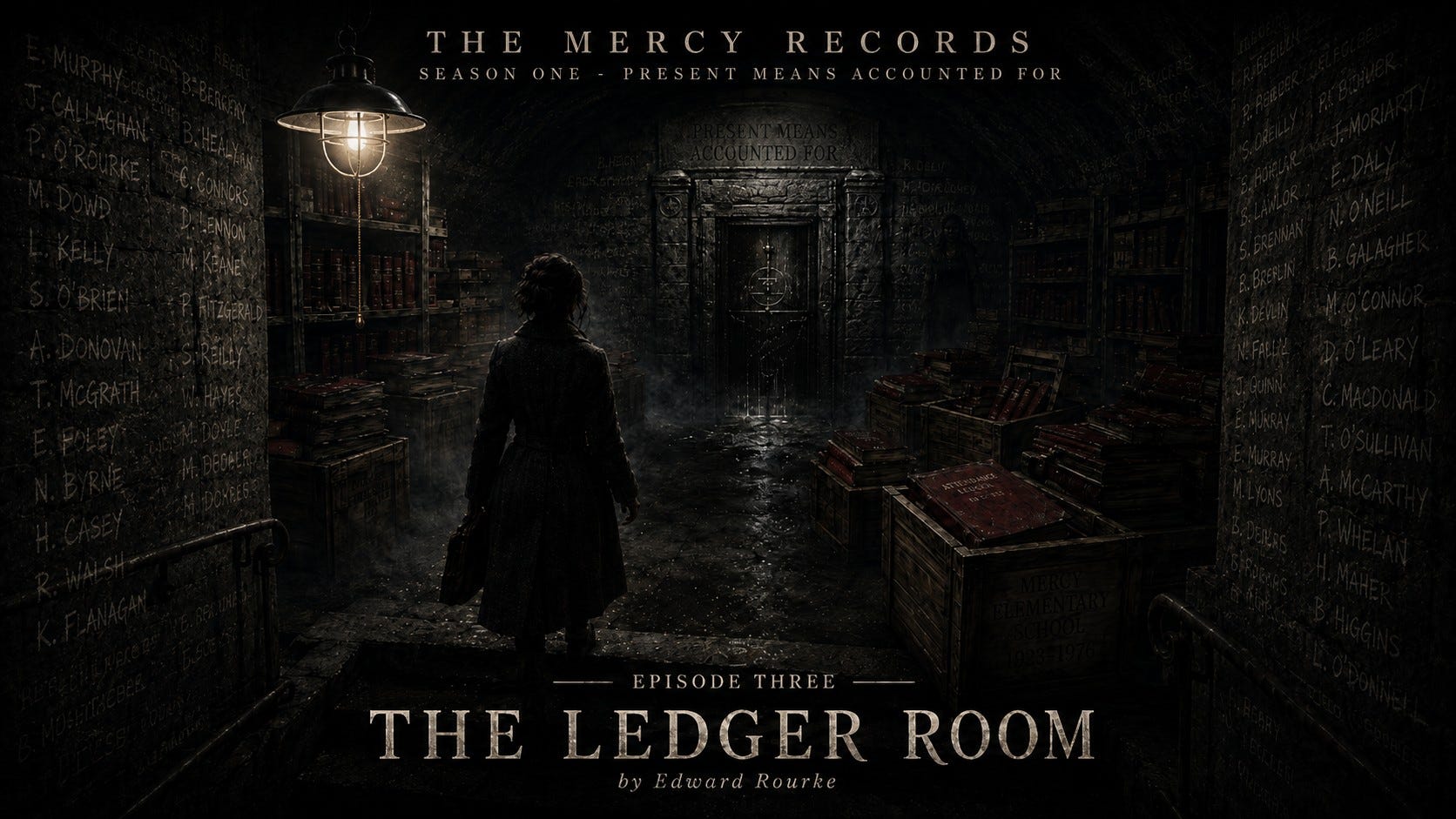
EPISODE THREE: THE LEDGER ROOM
by Edward Rourke
I.
Thursday morning. She had not slept in the interval she recognized as sleep. She had been lying in the dark with her eyes mostly closed, which was a different thing.
She had woken fully at three forty-seven. She knew this without looking at the clock on the nightstand. She had spent most of the night turning from her back to her right side, never allowing the room to pass fully behind her.
What she had learned in the night: the interval was not something that happened to her breathing. The interval had become her breathing’s default. She had been overriding it since the crates room and her body treated each override as temporary. A deviation to tolerate until the opportunity to return presented itself. It had been presenting itself. She had been returning, each time less certain she had chosen to return rather than simply stopped fighting.
She dressed in the dark.
Frank was at the kitchen table when she came downstairs. He had not been there when she went to bed. She had no evidence he had slept. He had a cup of coffee and he was not drinking it. The kitchen smelled of burnt coffee and cold and the specific silence of a man who has been thinking for a long time and has reached the point where the thinking stops producing new things and simply repeats what it has already produced.
She poured herself a cup and sat down.
“I’m going back in today,” she said.
He said nothing. His hands flat on the table the same way they went flat yesterday when she’d told him about the breathing. Not surprise. The specific movement of a man who has already made a decision about something and is watching the reason for that decision arrive.
“Nora.”
“There are records in there. Red cloth ledgers. Crates of them. I could see them through the gap above the door latch. I’m going in.”
“The door opens from below,” he said.
She looked at him.
“When it opens,” he said, “it opens from below.” He turned the cup. “I’m telling you this because you should know it. Not because I think it changes anything you’re going to do.”
She sat with that.
“The padlock on your basement door,” she said. “A way under the house?”
He was very still.
“I won’t go through your cellar,” she said carefully. “I’m going through the school. What I’m asking is — have you gone back? Since January?”
A long quiet.
“No,” he said.
“Is there anything in the crates room I need to know before I go in?”
He turned the cup on the table. Around and back. Around and back. A man performing the action of thinking when the thinking has been done for some time.
“The red cloth ledgers,” he said finally. “They go back as far as 1858. They aren’t in any order you’ll recognize.” A pause. “The names.” He stopped.
“What about the names?”
“Some of them you’ll know,” he said. “Some you won’t. The ones you don’t know — they’re not people who moved away or died. They’re people the town decided to stop knowing.” He looked at his hands. “The town is very good at deciding to stop knowing things.”
She thought about eleven piles of clothing on a stone floor. Wallets still with money.
“And the ones I will know?”
He was quiet for a long time. When he spoke, his voice had the quality of something being set down after a very long carry — not with relief, exactly. Just with the sound of a weight leaving hands.
“Your mother,” he said. “She’s in there. Helen. Under her maiden name.” He looked at the window. “Rankin. Helen Rankin. She went in in 1935. When she was a girl. What they did to her I don’t know the whole of. She never told me the whole of it.”
Nora held the cup.
“She was fine,” he said. “She was always — she was the most capable woman I ever knew. She went in and they did what they did and she came back and she had a life and we had a family and she died in 1971 and she was fine.”
The word fine, the fourth time he had used it for the same sentence, with the same voice, the voice of a man who understood the word was wrong and had no replacement.
“Dad. I need to know what’s in the ledger next to her name.”
He looked up.
“I know you know,” she said. “You worked in those buildings thirty-one years. You know every room. You’ve known about the sub-basement. You’ve known about the ledgers.”
“Nora—”
“What is next to her name?”
He was quiet for so long that she thought he would simply not answer. Then:
“W,” he said. “And below that: Bellamy line. Next: anticipated.”
She set the cup down.
“Anticipated,” she said.
“The entry was already there,” he said. “When your mother was processed in 1935 — the Bellamy line entry was already in the ledger, waiting. Blank space for the year.” He looked at the window. “She found it. In her own record. A child, eight years old, reading an entry below her name that was already anticipating the next one. She didn’t tell me until years later, and by then—” He stopped. “By then there were other things to think about.”
Years later. The phrase did not help. It was too vague and too careful and exactly the kind of phrase her father used when he was standing in front of something he would not name.
She let it pass.
“I’m going,” she said.
“I know,” he said.
She got up. She put on her coat. Right hand in right pocket.
“Nora.” He hadn’t moved from the table. “The door opens from below. I want you to understand what that means. It does not open from the crates room side. There is no handle on the crates room side.”
She stood in the kitchen doorway.
“It opens from below,” he said again, “and it has always opened from below, and it has been opening from below for a hundred and eighteen years, and it has only ever opened because something below it wanted it open.”
She went to work.
II.
The classroom was Thursday-ordinary. The children came in from the cold with their coats and their gym bags and their morning noise and they hung their things on the low hooks along the back wall and they took their seats and she called attendance and they were all present and she marked them present and she began the lesson.
Lily Arden was in her seat. Second row. She looked at Nora with the attention of a child who is listening to something other than the lesson. She did not contribute to the morning’s noise. She did not rustle. She sat with the perfect stillness of something that has been in that seat long enough to have learned stillness as a quality of the furniture itself.
Nora did not look at Lily Arden for more than a second at a time. This was the policy she had developed across three days in this classroom and she was keeping it the way she kept her hand in her right pocket. Not as a superstition but as the management of something she had confirmed was real and which she was not yet certain how to address directly.
The morning was reading comprehension and arithmetic, and the application of both to word problems involving units of measurement. She had taught this before. Her hands were steady. She called on Aaron Calloway for the third problem and Aaron worked it through on the chalkboard with the uncertain accuracy of a child who mostly understands and is performing confidence to cover the gap, which was not so different from what she was doing, and she thanked him and he sat down.
The smell was present. It was always present. She had stopped cataloguing it and simply noted: still here, still chalk and sweetness, still wrong in the specific way of something that has always been this way and intends to continue.
At ten forty-five, with twenty minutes left before the morning break, Lily raised her hand.
Nora looked at her. One second.
“Yes, Lily.”
“Miss Bellamy,” she said. Her voice was clear and small and exactly the voice of an eight-year-old child, every element correct, every element — with prolonged exposure — arriving slightly wrong, the way a sound in a recording can be correct in every measurable frequency and still not sound like a human voice when you have listened to it long enough. “There’s something under your lesson plan.”
Nora looked down at the desk. The lesson plan was there. She had set it down twenty minutes ago after Aaron Calloway’s problem.
“Thank you, Lily.”
She did not reach for the lesson plan.
Lily lowered her hand and returned her gaze to the front of the room and was still.
Nora finished the arithmetic. She called on three more children. She explained the correction for the child who had given the wrong unit in the second problem. The clock moved. The morning did what mornings do in third-grade classrooms.
When the children filed out for morning break she reached for the lesson plan.
She stopped before she touched it.
For three seconds the classroom continued being a classroom. Pencils remained in the grooved tray. The radiator clicked once under the windows. A chair leg settled against linoleum with a sound so ordinary it seemed indecent in the quiet after the children left.
Then the front edge of the lesson plan lifted.
Not much. The width of a fingernail.
It rose and settled again.
No hand touched it.
Nora did not move. Her right hand was still above the desk, fingers half-curled, not touching paper, not touching wood, not touching anything that could explain what she had just seen.
She waited until her breathing became something she could operate again. Then she lifted the lesson plan.
Under it was a key.
Not on a keychain. Not labeled. Iron, old. The kind of iron that has been oiled and used so long that the metal has taken on the specific quality of something touched repeatedly by many hands across many years. Heavy for its size. The kind of key that opened a door set into original foundation stone.
The paper above it had been flat. The desk beneath it was damp.
Not wet all over. Not spilled. Damp in the shape of a child’s hand, palm small, fingers narrow, pressed upward from inside the wood as if the desktop had remembered the hand after the hand had gone back down.
She touched the key.
The iron was warm.
Not pocket-warm. Not room-warm. Body-warm.
She closed her fingers around it and something beneath the desk closed its fingers around her wrist.
Small fingers.
Eight-year-old fingers.
Careful.
Taking attendance by touch.
Nora’s knees unlocked. Her mouth opened once and no sound came out of it. She pulled back hard enough that the desk scraped half an inch across the floor. The contact released immediately, professionally, as if it had only needed confirmation and had received it.
She stood there with the key in her hand and the red pressure marks fading around her wrist. Five places. Four fingers and a thumb. Already cooling.
The marks were too small for her wrist.
That was the part her mind refused first. They were not merely small. They were placed at the wrong angle, as if the hand below the desk had reached up through wood and bone and measured her from inside the joint.
For one ugly second she understood that if she screamed, every child would come back into the room and find their teacher holding an iron key over a desk that had just touched her.
And Lily Arden would already be sitting down.
She set the key on the desk.
She did not touch it again for the full fifteen minutes of morning break. She sat with it in front of her and she thought about what her father had said. The door opens from below. No handle on the crates room side. Opens because something below it wants it open.
The key was for a lock. If there was no handle on the crates room side, the lock was on the other side.
She thought about that differently. The lock wasn’t how it normally opened. The normal mechanism — opening from below — required something below to want it open. Something below had not wanted it open. Something below had provided an alternative.
Something below had given her the key.
She put the key in her coat pocket. Right pocket. With her right hand.
When the children came back in from the break, Lily Arden was the last one through the door. She walked to her seat. She sat down. She did not look at Nora.
She was smiling. Very slightly. Starting from the dead midpoint of her lips, moving outward in both directions simultaneously — past where smiles stopped, past the place where expressions have names, to a point that used the same muscles for a different purpose entirely. Not joy. Not satisfaction. The look of a thing that has been waiting in a particular spot for a very long time and has just watched the thing it was waiting for arrive.
Lily smiled without breathing.
That was what Nora noticed second.
The first thing was the mouth.
The second was that no air moved through the child while the expression widened. No nostril flare. No small throat movement. No living adjustment. The eyes stayed empty. The cheeks did not lift. The skin at the corners of the mouth simply kept accepting the instruction.
The smile was not an emotion.
It was a door opening.
The corners of Lily’s mouth made a small dry sound.
Not a crack. Not a tear. A settling sound, like old varnish accepting stress.
Then the bell in the corridor gave one soft, wrong tick without ringing, and every coat on the back wall shifted on its hook at the same time.
The children did not notice. Or they had noticed already and learned the Mercy Furnace way of not noticing.
Nora looked at the chalkboard and began the afternoon’s first lesson.
III.
Caleb Rusk ate lunch in Room 11.
This was not unusual. Room 11 was in the south corridor, last door on the right, and Mrs. Dodd kept the room unlocked during the lunch period on Tuesdays and Thursdays for students who, as she put it, might need a quieter space. Caleb had been using the quieter space since September, which meant he had been eating his lunch in Mrs. Dodd’s classroom since before the mark appeared on his wrist. This was the detail he had not yet worked out the significance of: she had offered the quieter space in the first week of school. Three weeks before the Health unit. Four weeks before she called him to stay after.
He was thinking about this while he ate his sandwich over the brown paper bag he’d folded it in, sitting at the front desk. Not the second row. Not the safer desk he had chosen on Tuesday when Dodd called him in after the mirrors. The front desk. The empty one. The one no student used. The one he had passed that day and asked her about because the cold came up through the floor beneath it with direction, with purpose. A cold spot. An old building. Nothing for you to think about. That was what she had said. He had been thinking about it since. So today he sat there on purpose, his sandwich untouched for the first minute, his right wrist warm under the cuff and the desktop cold through the paper bag and into the heel of his hand. He was not discovering the desk now. He was testing whether the lie changed shape when he put his body directly above it.
The workbook was at home, at the bottom of the back of his desk drawer, under everything. He had not opened it since last night, when he had opened it and found the handwriting that was not his and had closed it again and buried it again and spent the rest of the evening doing the specific nothing of a person who is very carefully not thinking about something.
He was thinking about it now. His mind had developed a habit of returning to it the way the tongue returns to a loose tooth — not to do anything, just to confirm it was still there.
I AM NOT THE FIRST CALEB.
She has been doing this since before your grandfather.
He had not drawn in seventeen days. Eighteen, as of this morning. His hand stopped before the decision was made — not a tremor, not a spasm, just a stopping, the pencil in his fingers and the sketchpad open and the hand simply not moving, the way a car idles before it moves but this one only idled, only ever idled now. He had told himself it was a block. He was thirteen years old and had been drawing his whole life and he knew it was not a block. A block was when the ideas stopped. The ideas had not stopped. The hand had stopped.
The mark was at four fingers.
He measured it every morning by pressing four fingers horizontally against the inside of his right wrist, base of palm, and the edge of the mark was just above the top of the fourth finger. Last week it had been five. The week before, six.
The warmth of it was its own kind of wrong. Not fever-warmth — clean and directed, the warmth of something doing a specific thing and the heat was a byproduct of the doing. His pulse was in it. His pulse, and then, below his pulse, at a slower interval, something else pulsing that was not his pulse and did not vary the way his pulse varied when he stood up too fast or ran the length of the gym.
Fixed interval.
He ate the sandwich.
Mrs. Dodd came in at twelve forty, ten minutes before the lunch period ended. She came in the way she always came in — directly, economically, a woman who had decided long ago that unnecessary movement was a form of waste. She set her things on the desk. She looked at him.
“You’re thinking about the workbook,” she said.
He did not say yes. He did not say no.
“That’s all right,” she said. She sat on the edge of the desk, facing him. “It’s meant to be thought about. That’s what it’s for.”
“Who wrote in it?” he said.
She looked at him with the warmth she always used — patient, specific, the warmth of a person who is genuinely interested in this particular child. He had trusted this warmth for six weeks. He was still, despite everything, not fully able to stop trusting it. This was the most frightening thing about it: that he knew what it was and it still worked.
“You did,” she said.
“No.”
“Not the you that sat down with a pencil,” she said. “The other part of you. The part this is developing in.” She nodded toward his wrist. He had his cuff pulled down. “It’s expressing itself. The way drawing expresses itself. But this is different from drawing. This is older.”
“I want it to stop,” he said.
The warmth in her face did not change. This was the thing about the warmth: it did not change in response to him. It was maintained at a consistent temperature regardless of what he said. He had thought, for six weeks, that this was what professional warmth felt like. He was revising this opinion.
“Tell me,” he said, “what it’s for. Exactly.”
She looked at him. For two seconds the warmth was in her face and her eyes were doing the calculation behind it. Something precise and quick, the flicker of an addition being done. Then it was gone. The warmth was still in place but she had let something show behind it, just for those two seconds, and what had shown behind it was not unkind and was not cruel and had absolutely no relationship to Caleb Rusk as a person. It looked at him the way a carpenter looks at a plank. Not dismissively, not cruelly. Professionally. Interested in its structural properties.
The warmth came back over it like a blind being lowered.
“It’s for you,” she said. “All of it is for you.”
He picked up his gym bag.
“Don’t stop fighting it,” she said, as he went to the door.
He stopped.
“I mean that,” she said. “I need you to not stop fighting it for a while yet. There’s a process.”
The mark warmed under his cuff.
Caleb closed his left hand over the right, around the cuff, pressing the cloth down, pressing the mark underneath, pressing hard enough that Mrs. Dodd could see the strain in his neck, in his shoulders.
Mrs. Dodd did not look down.
“Don’t press on it so hard,” she said. “Pressure makes it answer.”
His left hand opened.
His right hand did not.
The fingers had tightened into a fist. Not enough to hurt. Enough to hold. The mark pulsed once under his thumb, then again, not with his pulse, not with any rhythm his body had permission to make. Clean. Fixed. Waiting for the next interval.
His stomach dropped so suddenly he thought he might be sick into his lunch bag.
Then the thumb pressing the mark moved without him.
It dragged once, slowly, along the inside of his wrist, opening the skin sensation without opening the skin. Caleb felt the line continue past where his thumb stopped, felt it travel under the cuff toward the base of his palm, as if something below the mark had taken the idea of his touch and kept using it.
He made a sound then. Small. Not a word.
Mrs. Dodd smiled the way adults smile when a child has finally pronounced a difficult term correctly.
Caleb pulled his hand free and the cuff rode up.
Mrs. Dodd looked at the mark then. Not at his face. At the mark. For one second her professional warmth thinned and he saw the look beneath it again: not cruelty, not dislike, not anything personal enough to hate. A carpenter looking down the length of a board.
“Fighting is part of the process,” she said.
He picked up his gym bag.
At the door he saw the anatomy chart on the side wall — the nervous system, the red-pencil annotation beside the brain stem in Mrs. Dodd’s handwriting, two words he had never cared enough to read.
He could read them now.
Not because he had moved closer.
Because the chart had changed.
The printed brain-stem illustration had turned on the paper. Only slightly. Enough to face him. Enough for the two red words to align with his eyes.
MOTOR THRESHOLD.
Behind him, Mrs. Dodd said, “That’s where the door is.”
The printed nerves on the chart darkened by one shade.
The red line from the brain stem to the hand looked wet.
Caleb felt his own fingers answer it, one at a time, tapping against his gym bag strap in a sequence he did not know but his wrist did.
Caleb left.
He stood in the south corridor for a long time before he went back to his regular class.
He thought about the phrase “I need you….” He thought about what it contained and what it did not contain.
That afternoon, in his bedroom, he opened the workbook.
There was new writing. It was in his handwriting.
It said: THE HAND THAT DRAWS WHAT COMES NEXT IS NOT LOST. IT IS REDIRECTED. THE DRAWING WILL HAPPEN. YOU CANNOT PREVENT THE DRAWING. YOU CAN CHOOSE WHAT IS DRAWN.
He stared at it for a long time. Then he took out a pencil. He placed the tip against a blank page.
His hand did not stop.
His hand began to move.
He watched what came out of it the way you watch something happen to someone else — present, aware, not in control. The pencil moved with a surety that his hand had never had in all his years of drawing: no correction, no second line, no tentative mark. The first line was the right line. The second. The third. The picture assembled itself with the specificity of something being reported rather than imagined, a record of something that exists and is being documented, not invented.
He watched his hand draw the sub-basement of Mercy Furnace Elementary.
Not a building he had ever entered. Not a space he had any access to. The corridor appeared in his pencil’s lines — the packed earth walls, the wooden boards bowed slightly outward, the corridor light at the base of the stairs. The narrow wooden doors in the foundation wall. The crates room beyond, ceiling vaulting at the center, original stone overhead. The far wall.
The door set into the stone.
The carving above it.
He could not read the carving from this angle — his hand was drawing the room as seen from the doorway, and the letters above the chamber door were too small for legibility. His hand did not go closer. His hand was not drawing from imagination; it was drawing from a fixed vantage point, and the vantage point did not move.
He watched his hand draw a figure in the far corner of the crates room.
Standing. Not near the chamber door. In the far left corner, where the ceiling came lowest. Not moving. Not turned toward the door or toward the corridor. Turned toward the stairs. Toward where a person coming down the stairs would appear.
His hand put the figure’s face in shadow and stopped.
Caleb waited for it to finish.
It did not.
He let out one breath.
On the page, where the face should have been, a second pencil line appeared.
Not under his pencil.
Not from his hand.
Across the room. On the paper. A line drawn from inside the page outward, darkening itself into the shadow his hand had left unfinished.
Then another line.
Then the head in the drawing turned.
Nothing moved on the desk. The pencil was still in his fingers. His hand was still. The paper was flat. But the figure in the corner of the crates room had changed position with the horrible economy of something aware of being observed.
Caleb’s nose began to bleed.
The first drop struck the paper beside the chamber door. It did not spread normally. It ran along the pencil line, following the drawn edge of the door, darkening only the doorway, as if the drawing knew where blood belonged.
He pulled his hand away so violently the pencil snapped.
The broken tip stayed on the page.
It rolled once by itself and pointed toward the stairs.
Then a second drawing began in the lower margin.
No pencil touched it.
A rectangle. A narrow bed. A boy seen from above.
Caleb knew his own room before the walls were finished. He knew the chair with the jeans over the back. He knew the window. He knew the sketchpad on the desk.
The figure in the first drawing was looking up the stairs.
The thing drawing the second picture was looking down at him.
He put the pencil down.
He closed the sketchpad. He went to the kitchen and ate supper with his mother and did not talk about any of it.
His mother hummed while she cooked. The same fragment, small and aimless. He heard it now as if for the first time. The interval of it. The rhythm.
He did not say anything about the rhythm.
After supper he sat at the kitchen table and measured the mark. Four fingers from the drawing hand. He pressed the four fingers against the inside of his wrist and looked at where the mark ended.
It was past the fourth finger. Barely — a fraction — but past.
He pulled the cuff down. He went to bed.
In the night he woke.
Not from a dream. He woke the way you wake when a sound has stopped rather than started — when the silence is the wrong shape for the room. His room was dark and his right hand — the drawing hand — was not where he had left it.
It was extended above him. Not at his side, not curled against his chest. Extended, palm down, fingers slightly spread, held in the dark above his face with the patient, purposeful positioning of a hand that knows what it is doing. He lay still. He did not lower it immediately. He could not. Some part of him understood that he needed to observe this the way you observe something at the edge of the yard in the dark — without sudden movement, without calling its attention to you. He looked at his own hand above him in the dark and it looked like his hand and it was his hand and he did not know this the way he had always known it before. The knowing had a gap in it now. His hand. In the dark above his face. Patient. Waiting for something. The fingers slightly spread, as if testing the air. As if listening for something his wrist could feel and his mind could not.
He lowered it. He held it against his sternum and lay in the dark and did not reach for the pencil on the desk. He already knew the pencil did not need him to reach for it anymore.
His fingers kept trying to spread.
He held them down with his left hand and felt them work under his palm like something trapped in a sack.
From the desk came one soft roll.
The broken pencil tip touched the lip of the sketchpad and stopped.
Caleb shut his eyes and tasted graphite at the back of his tongue.
He lay in the dark with his drawing hand pressed flat against his ribs and waited for morning.
IV.
She went below at five-thirty.
The building had done its after-hours settling. The other teachers had been gone since four. The custodian did his last round at six-thirty, locking up room by room, working front to back, which gave her about an hour. She had considered this and decided it was not the most important thing on the list of things to consider.
East wing. Back hall past the boiler room. The institutional-green door. The hasp open where she had left it.
She put her hand on the door.
The warmth came through immediately. Body-temperature. Patient. Not the warmth of pipes or stone holding the day’s heat. The warmth of something living. She registered this first in the palm of her hand and then in the base of her throat — a cold contraction, something the body does before the mind has formed a response, the way the stomach moves before a fall. She had confirmed this twice before. She confirmed it again now: the warmth was wrong. The warmth had always been wrong. She had simply been categorizing it differently until this moment, standing at the top of twelve steps with the full weight of what was at the bottom of them finally making itself felt in her chest. It had been waiting the same way it had been waiting both times before — without impatience, without any quality of waiting that implied a passage of time. It simply was. The door was warm. Below was warm. She was here and it was warm and this was neither welcome nor threat. It was the specific warmth of an arrangement that had existed for a very long time and did not require her arrival or departure to continue existing. This did not make it better. This was the thing she understood now that she had not understood before: the absence of malice was not the same as safety. The warmth did not want to hurt her. The warmth simply was, and she was in it, and it was patient.
She opened the door.
Twelve steps. She counted them going down. She had counted them on Wednesday too, and she understood now that she was going to count them every time — the count was a form of control, a small rule she had made for herself because the other rules were not available. She knew exactly how many steps were behind her when she reached the bottom, which meant she knew exactly how many were in front of her if she needed to go up in the dark.
The concrete landing. The wall switch to the right — she found it without looking, the same toggle in the same place. The corridor came on: the caged ceiling fixture, flat yellow light, dimly revealing the boards in the walls bowed slightly outward, the floor concrete for the first ten feet and then packed earth, darker and damper. She moved to the narrow wooden doors in the foundation wall. The latch lifted. She went into the crates room.
The pull-chain hung from the vault’s center. She found it and pulled. The second bulb came on — lower-watt, dimmer yet, the crates room resolving out of near-dark into something navigable.
The smell was at full intensity here — chalk and sweetness thickened below the school’s basement into something older, more concentrated, as if the smell had been accumulating in this space for a very long time without anywhere to go. She had begun to understand that the smell was not a byproduct. It was a quality of the place itself, the way a church has its smell and a library has its smell — specific, irreducible, evidence of what has happened in the space and for how long.
She passed the end crate. The red coat was there — folded, arms crossed, front side down. She confirmed it without touching it. She moved on.
The key was in her right pocket. She had moved it there from her coat in the morning and it had sat against her right palm all day, heavy, warmer than ambient temperature, the specific warmth of worked iron that had been held by many hands.
The far wall.
The chamber door.
The carving above it: PRESENT MEANS ACCOUNTED FOR. She read it the same way she had read it the first time — not as a sentence but as a weight, something that had accumulated meaning across a very long time of being read and confirmed and enacted. The letters were three inches deep. She thought about the deliberateness of that depth. Not a label. A statement meant to outlast the person who cut it.
She looked at the door.
The wood was dark with age and with whatever the air in this room had done to it across many decades. No hasp on this side. No handle — she noted that yesterday. What she had not been able to do was examine it closely, and she did that now, bringing the key close and moving along the door’s edge. At chest height, barely visible in the shadow where the door met the stone: a keyhole. Set into an iron plate surface-mounted to the stone beside the door — not in the door itself, in the stone. So that whatever lock the key fit was in the stone wall, and the door was bolted to it, and the bolt released the door from the stone to allow it to open.
She put the key in the lock.
It turned with the specific ease of a lock that has been maintained. Not sticky, not seized. Turned, the mechanism releasing cleanly, a bolt drawing back in the stone, and the chamber door moved inward two inches on its own as the lock released, pushed by whatever pressure differential existed between the crates room and what was behind the door.
The smell came through the two-inch gap first.
The same chalk-and-sweetness, but not thickened — clarified. Not stronger; cleaner. More precise. The smell of the crates room was the accumulated exhalation of the long closed space above. What came through the gap was the smell of what was below that — the original smell, what the town’s particular quality had smelled like before it had been filtered through a century of stone and wood and institutional accumulation.
It smelled like nothing she had ever smelled and she had been breathing its diluted version since she arrived.
She pushed the door open.
V.
The record room was smaller than the crates room. Stone walls on all sides — the same original foundation stone, the same massive dry-laid blocks, no mortar. The ceiling was lower. A single oil lamp sat on a stone shelf to the right of the door.
The walls.
Every surface of every wall was covered in names.
Not carved — written. In many different hands, in many different materials: black paint, red paint, what appeared to be ink, what appeared to be chalk, what appeared to be — she did not complete this observation. Different sizes. Different dates beside the names, some in pencil, some in the same red-cloth-ledger hand she had come to associate with Miss Pryce’s copperplate. Column by column, name by name, floor to ceiling, the stone covered so completely that in some places the names had been written over names, newer hands on top of older ones, the earlier names still visible as negative space where the newer ones had darkened around them.
She moved her eyes across them and did not look for specific names yet. She gave herself this: not yet. She looked at the number of them first. The density. The full inventory of a hundred and eighteen years of this.
The ceiling.
The ceiling had names too. Forty-one of them, she would count later — now she looked up and saw names on stone overhead and noted that they were in a different quality of material, a different quality of hand, something that had been applied with care and finality, and that the ceiling names and the wall names were different things even before she knew the taxonomy of their difference.
The floor.
Stone. Pale stains, darker at the edges, body-temperature warm when she crouched and pressed her fingers against the stone — she did this without deciding to, the muscle memory of someone checking for something she already knew. Warm. The stains were thickest in the center of the room. They were the evidence of transit. The record of passage.
She stood.
She used the matches from her coat pocket. The lamp came up and the room increased — the walls resolved out of shadow, the names clarified, the ceiling became readable. She lifted the lamp and moved to the left wall.
She whispered her own name once, softly, to prove the room still behaved like a room.
“Nora Bell—”
The last syllable did not leave her mouth.
It stopped between her teeth. Not caught in her throat. Taken.
She closed her mouth and felt the missing sound sitting behind her tongue, cold and round and no longer hers.
The lamp flame leaned toward the wall names, not upward.
The red cloth ledgers were in the far corner: a wooden shelf, low, built directly into the stone. Eight ledgers, red cloth covers, spines facing out. The earliest date on the spines was 1858. The most recent: 1962.
She took the 1935 ledger. She took it to the center of the room and held the lamp over it and opened it.
The entries were in Pryce’s copperplate — consistent across every decade she sampled, the same hand in 1858 as in 1962, the same character and weight and patience of the script. Each entry: a last name, first name, a date, and a classification mark. W. A. V. Others she did not know and filed for later.
She found Helen Rankin in the third column of the 1935 entries.
Rankin, Helen. October 14, 1935. W. And below, in smaller script, the same hand: Bellamy line. Next: anticipated.
She stood in the record room with the lamp and her mother’s name and breathed.
Her mother had been eight years old. Her mother had been brought into a room below a school and processed, and below her name someone — something — had already written the next name. The next line. Had already looked forward down the Bellamy line and written: anticipated. Had already known.
The lamp was warm in her hand. The room was very quiet. The names on the walls were very still and very many and they were all someone’s mother or someone’s daughter and the stains on the floor at the center of the room were body-temperature warm when she had pressed her fingers against them and she did not need to complete that thought to understand it.
She looked at the entry again: Bellamy line. Next: anticipated.
Below it, in the blank space the ledger had left for the year: no year. Not because the entry had not been made. Because whoever made it had not needed a year. Had been willing to wait.
The blank space was not empty. The blank space was patient.
Her hand was shaking. She noticed this with the same detached precision she had been bringing to everything in this room — her hand is shaking, the lamp is warm, the stains are warm, the blank space is patient — and she pressed the hand against her thigh until it stopped shaking and she looked at the other entries.
The classification marks. W. A. V. She found all three in the 1935 entries. She found them in the 1890s entries and the 1910s entries and the entries from the late 1950s and early 1960s, the last years in the most recent ledger. The same marks. The same hand. A hundred and four years of the same hand writing the same marks beside the same kinds of names.
And in the 1958 entries, in the last ledger, in a column of five names: Robert Bellamy.
The lamp was very steady in her hand and her breathing was very steady and the room was very quiet.
Robert Bellamy. October 14, 1958. V.
She did not remember his face.
That was the mercy.
Then the room took the mercy back.
For one second she remembered a sleeve. Brown corduroy. A missing button. A boy’s hand holding toast at the kitchen table. The small annoyed motion of him scraping burnt edges into his plate because Helen had made it too dark and he was hungry enough to eat it anyway.
Then the memory folded shut.
Not faded.
Closed.
Like a file drawer.
The memory left an afterimage in her hand.
Small fingers sticky with butter. A boy pulling away because sisters were irritating and he was eight and alive and wanted the bigger piece of toast.
Nora’s hand closed on nothing.
Across the room, one of the wall names made a soft chalking sound.
She did not look for which one. She already knew what looking cost here.
Below his name, in the same smaller script: Bellamy line. Nora: anticipated.
She had come into this room to find her mother’s name. She had found her mother’s name. She had found her brother’s name. She had found her own name, in the handwriting of something that had been making this particular entry for a hundred and eighteen years, in a room below a school where she had spent the last four days teaching third grade, and the entry next to her name was not a classification mark.
It was a date.
It was a blank space where a date was supposed to go.
It was today’s date, written in pencil, fresh.
Today. October 21, 1976.
She stared at it and understood several things at once. She understood that the entry had not been there when she opened the ledger. She understood that the pencil beside the shelf was the only pencil in the room. She understood that her hands had not touched it.
The paper dented beside her name.
Nora saw it happen.
A small depression appeared in the ledger page, just to the right of the fresh date, as if an invisible fingertip had pressed the paper down to hold the line in place while the graphite settled.
The date darkened.
Not much.
Enough.
Behind her, the breathing began.
One breath.
A pause.
One breath.
No throat clearing. No fabric shift. No living adjustment. The same interval. The same patience. Close enough to warm the back of her collar.
The tiny hairs at the base of her neck lifted and then lay down, one by one, under the pressure of that breath.
Her bladder clenched with a crude animal panic so sudden it filled her eyes with water.
She hated that. Hated the body for telling the truth before the mind could arrange dignity around it.
The thing behind her breathed again.
This time her shoulders moved with it.
She understood that she was not alone in the record room. The understanding arrived in her body before her mind had finished the sentence — a drop, a sudden cold absence at the center of her, a tightening so deep and animal that for one humiliating second she was not a teacher, not a daughter, not a Witness, not anything with a name.
She was meat deciding whether to run.
The lamp shook once.
The flame leaned backward, toward whatever stood behind her.
Nora did not turn around.
Her body had made this decision before her mind was consulted. Her body had received information that her mind was still processing and had already filed its recommendation: do not look. Looking would make the encounter more formal than she could survive.
If she turned around, she would be seen seeing it.
The room had already taken the last syllable of her name.
She understood, without words, that if she gave it her face too, it would know where to put the rest of her.
A finger touched the ledger page beside her name.
She saw the paper dent.
She saw the fresh pencil date darken again.
She saw no hand.
A pressure touched the back of her right hand.
Not skin. Not exactly.
The idea of skin pressed through cold air and arranged her fingers around the ledger cover.
Helping her close it.
Teaching her the motion.
Nora closed the ledger.
The breathing stopped the instant the covers met.
That was worse.
She set the ledger on the shelf. She did not look at the pencil. She did not look at the walls. She put the key in her right pocket. She walked to the door and through it and pulled it closed behind her and crossed the crates room and went through the foundation doors and into the corridor and up the twelve stairs without running.
At step seven she heard the ledger reopen below her.
At step eight she heard pencil.
At step nine she forgot what her mother’s voice sounded like.
At step ten she remembered Robert’s sleeve again and almost fell.
At step eleven the breath below matched hers.
At step twelve it kept breathing after she stopped.
It took a long time.
The thing she would not stop thinking about, walking home in the dark on the streets of Mercy Furnace: not what was written beside her name. Not even that it had been written while she was there, in the room, with her back turned.
The thing she would not stop thinking about was the date.
Not a future date. Not a classification. A date — today’s date, October 21, 1976 — written beside her name in the same way all the other dates were written beside all the other names: after the fact. The way you write a date beside a name when the thing the date records has already happened.
She walked home in the dark with this and she did not run. Not because she was not afraid. She had stopped having a clear inventory of what she was afraid of sometime around the moment she understood that the date had been written while she was standing in the room. What she had instead was the full-body knowledge, coming up through the soles of her feet and into her legs and into the place under her sternum where she kept whatever was left of the ordinary logic of her life — that running would not help. That whatever had written the date was not behind her on the street. That it did not need to be behind her on the street. That it had written the date, and the date was today, and the date was past, and it had already happened, whatever it was, and she was walking home from it even now, even in this moment, walking through the already-happened thing without knowing which part of the evening had been the thing itself. This was the part that made her chest tight in a way no locked door or dark staircase had managed. The event had occurred. She simply could not yet identify it. She was inside it. She was already on the other side of it. She walked home.
She did not run because she understood, with the cold precision of someone who has just finished reading a document that was always going to say what it said, that whatever the date recorded had already occurred. Was already in the record. Was not something she could outrun on any street in any town, at any speed, for any distance.
She walked home.
She did not tell her father what she had found beside her name.
She did not tell him because she could see, from the kitchen, that he was already sitting at the table with his coffee going cold, and his hands were flat on the table, and he had known she was back before she opened the door.
“Nora,” he said.
She opened her mouth to answer.
Her voice came from the basement door.
“I’m here.”
Frank’s hands went flatter on the table. The coffee in his cup trembled once, a small black circle shivering inside the porcelain.
Nora turned.
The basement door was closed.
The keyhole was dark.
From the other side came one careful breath.
The key in Nora’s pocket warmed until she had to close her fist around the cloth to keep from crying out.
On the basement door, at the height of a child’s hand, five damp marks appeared in the paint.
They were not pushing out.
They were pushing in.
Frank stood so fast the chair struck the wall.
“Do not answer again,” he said.
From the basement door, in Nora’s voice, very softly, something answered, “Present.”
— End of Episode Three: THE LEDGER ROOM —
Continue with Episode Four: SLAG HILL WOODS
Episode Four is available to paid subscribers.
Six boys. A Friday night after the game. Rolling Rock, autumn dark, and the tree line waiting at the edge of town. Tommy Gruner gets close enough to see what is in their hands.
Continue with Episode Four.
Author’s Note
Edward Rourke
Thank you. Genuinely. Episode Three asks you to go where Nora has been avoiding since she first understood there was a below.
The ledger room is not only a place where records are kept. It is a place that keeps people. Names, dates, ledgers, warm stains, ceiling entries, wall entries — all of it looks administrative until Nora realizes the archive is not passive. It is watching the person who has come to read it.
Helen Rankin’s name changes Nora’s understanding of her mother. Robert Bellamy’s name changes the shape of the family history. The Bellamys do not have one absence. They have layers of absence, and Mercy Furnace has trained the living to survive by not saying certain names too clearly.
The moment that matters most to me is not only the name in the ledger. It is what happens after the name: Nora understands that she is physically not alone. Close enough for breath to touch her collar. Close enough for the room to take away the usefulness of evidence. She came looking for records. Something in the record room looked back.
Caleb’s terror moves along a different line. His drawing hand works again, but what comes through it is not freedom. It is documentation. The sub-basement. The crates. The room under the room. His most private gift has been redirected toward a system that already knows how to use him.
By the end, neither Nora nor Caleb has escaped cleanly. Nora leaves the record room, but the record room has kept part of her voice and sent something home with it. Caleb lowers his hand in the dark, but he has already felt it above his face, positioned as if it belonged to someone else.
Episode Four is SLAG HILL WOODS. The school is not the only place in Mercy Furnace where the town has learned to hide what it has done.
Thank you for staying in the room this long.
Get some sleep if you can.
— E.R.
Back catalog — July Ashes • Threshold • Second Formula — available under Edward Rourke at Amazon.
THE MERCY RECORDS, Season One: Present Means Accounted For © Edward Rourke. All rights reserved. Episodes 4–13 available to paid subscribers.