THE MERCY RECORDS
Season One: Present Means Accounted For
EPISODE TWO: ATTENDANCE
by Edward Rourke
BEFORE
At seven thirty-eight Tuesday morning, before the first bell and before Caleb Rusk came upstairs, the second-floor boys’ bathroom already had someone in it.
His name was Michael Vasko. Seventh grade. Twelve years old. Too thin in the wrists, with a cowlick he had stopped trying to flatten and a canvas book bag he carried by one strap because both straps made him look younger. He had come in because the downstairs bathroom had two eighth-graders smoking in the end stall and because being late to homeroom was better than being noticed by boys who had already decided what kind of day they wanted to have.
The bathroom was empty when he pushed through the door.
That was what he thought first.
Then he heard the tap running.
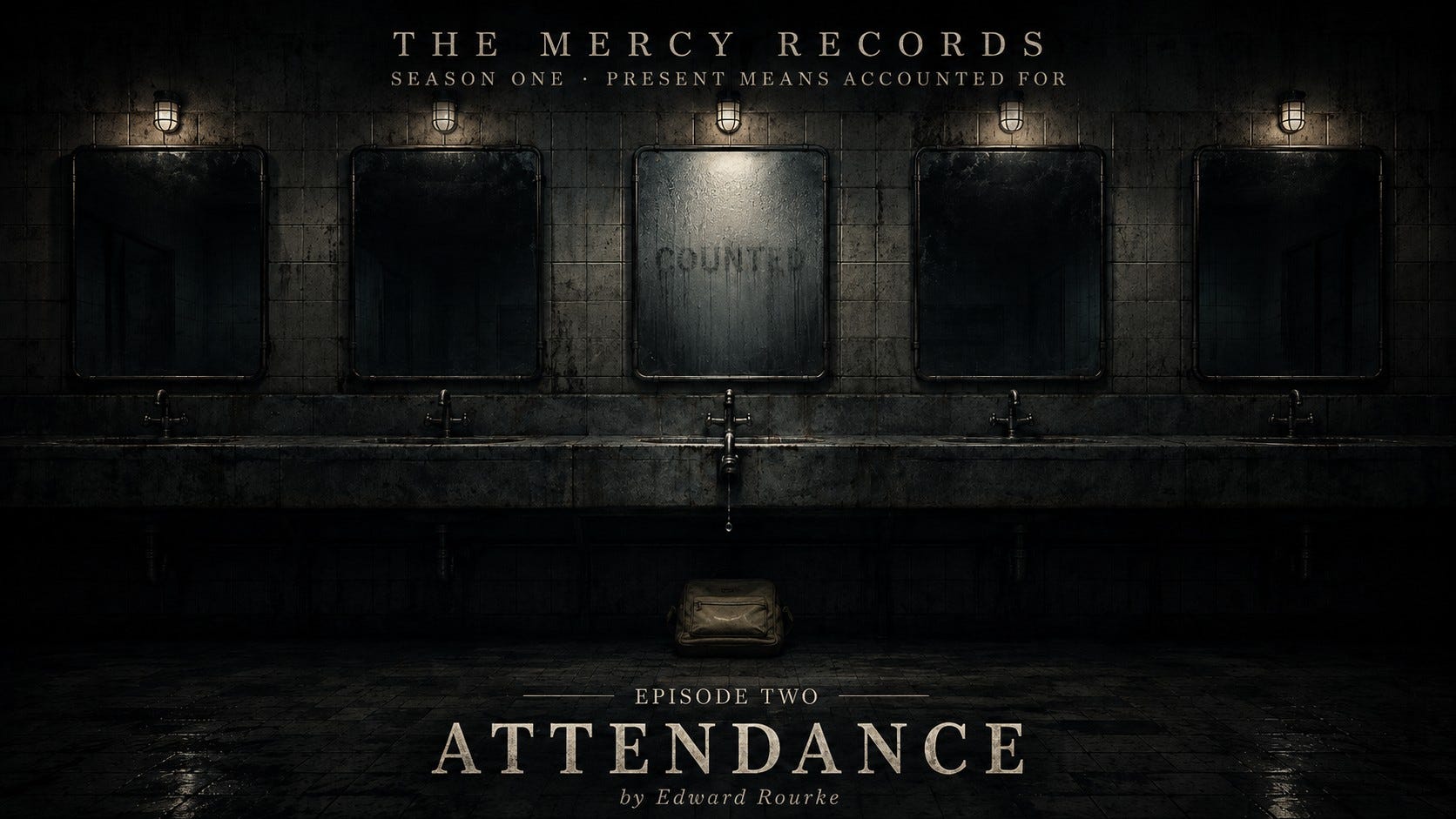
Not loud. Not full pressure. A thin thread of water from the center sink, striking porcelain with a steady sound that made the room feel occupied by something patient. Michael stood just inside the door with one hand still on the push plate. Five mirrors over five sinks. Five pale rectangles. Five versions of the same morning light, fluorescent and flat and unkind.
The center mirror was fogged.
That made no sense. The water was cold. He could hear cold water. He could see no steam rising from the sink. But the glass had gone gray from the inside out, as if someone had breathed on it from behind the silver and was waiting for the surface to receive the message.
Michael took one step forward, not because he wanted to but because his body had not yet understood that curiosity and obedience were sometimes the same thing. Cold came up from the floor around his ankles, the way it does in old tile bathrooms before the heat has reached them. The bathroom smelled of institutional soap, wet paper towel, and under that, faintly, chalk dust. Chalk dust did not belong in a bathroom.
The fog in the center mirror thinned at the edges. A letter almost formed. Then did not. The surface cleared just enough for him to see himself standing there with his canvas book bag sagging against his hip and his mouth slightly open in the foolish way people look when they do not know they are afraid yet.
His reflection raised its right hand.
Michael did not.
The reflected hand lifted slowly to the reflected mouth and pressed one finger against the lips. Hush.
Behind him, inside the far stall, a girl’s vinyl book bag slid out from under the door and stopped exactly between his shoes.
No girl spoke. No feet showed under the stall wall. The bag was pale yellow, with a cracked plastic handle and a black scuff across one corner. A girl’s name had been written on masking tape and pressed to the front flap, but the tape had been rubbed so thin he could not read it.
The center mirror fogged again.
This time the word arrived complete enough to be almost legible before it sank back behind the glass.
COUNTED.
Michael made a sound too small to be useful. The reflection lowered its hand. Its mouth smiled without changing his.
The first bell rang downstairs.
He ran. He left the vinyl book bag where it was. By the time Caleb Rusk came through the same door seven minutes later, the bag was gone, the tap was still running, and all five mirrors were waiting.
I.
The building diagram was waiting in the desk drawer on Tuesday morning.
Under the lesson plans — lying flat, as if placed before she arrived and left without urgency, the way things are left when whoever left them was certain they would be found. She lifted the lesson plans out and set them aside and picked it up.
It was old. Not recently old. The paper had gone the particular yellow of documents kept in a closed drawer for years, soft at the folds from being opened and refolded more times than one person had needed to refold it. Someone had drawn the building footprint by hand, in ink, carefully — first floor and second floor labeled in small precise capitals, the 1940s addition noted in a different ink, the 1960s addition in a third hand, a ballpoint, the lines less careful, added to a document that had already been in use for years before that wing existed.
She turned it over. Nothing on the back. She turned it face-up and looked carefully at what it showed and at what it did not show.
No basement. No sub-basement. No lower levels of any kind. The building ended at the ground floor. The ground floor ended at the earth. Whatever was below the earth was not on this document and had never been added to it, in any of the three hands that had contributed to it across however many years it had been kept in this particular drawer.
She stood in Miss Pryce’s classroom with the diagram in her hands and made herself breathe at a normal rate, and the smell of the room was already there — chalk dust and paste and underneath it the older thing, the thing she had been breathing since Monday, present now in the way of something that has stopped trying to stay hidden and is simply present — and she refolded the diagram along its existing creases. Where each fold went, it went without resistance. The paper remembered.
She put it back under the lesson plans. Where it had been.
Tuesday. October 19, 1976. Her second day.
The children arrived. The day began.
II.
If you asked the teachers at St. Bartholomew Junior High about Caleb Rusk, most of them would give you the same things in different orders. Two absences since September, both with notes from his mother, both technically excused. Three detentions. A discipline file that had required a second folder back in sixth grade and had never shrunk. They would tell you about the jacket — olive drab, too large, the kind that said I am not going to make this easy for you — and about the way he moved along the walls of corridors rather than the center, the way his eyes logged every room he passed, the body language of a kid who had decided in fifth grade that expectations were a debt he hadn’t agreed to carry.
They would not tell you about the drawings. They hadn’t seen them. The drawings were private in the way breathing is private — automatic, unconscious, the thing his hand did when the rest of him was occupied elsewhere. He had never shown anyone. He had never considered it.
He woke Tuesday morning with the heat behind his right ear already there.
Not a headache. Headaches had edges. This was warmth in the bone itself, radiating forward along his jaw, and it had been there every morning for two weeks and he had stopped waiting for it to be gone. The room, the cold window, and behind his right ear: the heat.
He dressed in the dark. Jeans. A white undershirt, then the flannel — the blue one, the only one that was actually warm — then the jacket over that. He sat on the edge of the bed to pull on his socks and his hand stopped on the second one because the warmth at his wrist had started.
Two weeks ago it had been warmth only. He had pressed his thumb to the inside of his right wrist and told himself: nothing. A circulation thing. The kind of nothing that goes away.
It hadn’t gone away. It had darkened.
He turned on the desk lamp and held his wrist under it.
Inside of the right wrist, at the pulse point, positioned with a precision that had no business being there: a dark line, not a bruise, not any damage he could account for by contact or friction. Something pressed into the skin from beneath. Several finger-widths up from where the wrist met the palm, toward the elbow. Slightly raised. Warm when he touched it. Warm before he touched it.
He turned the lamp off and finished dressing in the dark.
He sat on the bed’s edge a moment more, pressing his thumb to the mark through his flannel cuff. The warmth of it came through the fabric immediately — specific and alive, the warmth of something doing a thing and generating heat as a byproduct of the doing. He pressed harder. The mark pressed back. Not resistance. Rhythm. A pulse, distinct from the one in his thumb, at its own interval, not consulting him about it, not slowing because he needed it to slow.
He grabbed his gym bag and went downstairs.
His mother was at the kitchen sink. Back to the room, hands in the dishwater, humming — three notes, the same three notes, a fragment without a beginning he’d ever heard or an end she ever reached. He had been hearing it his whole life. It had never arrived in his back teeth before two weeks ago. Now it did. Now some mornings the interval of those three notes landed there like a frequency his body had learned, against his will, to receive.
“Morning,” he said.
She turned around.
She didn’t usually turn around in the mornings. She was a back-of-the-room, over-the-shoulder person when there was a bus to catch. She turned around fully and her gaze came up from the sink — one second, just one, before it found his face — and in that second her eyes went to his wrist.
Not his hand. Not his face. His wrist. The right one. The inside of it, where the flannel cuff covered the mark.
One second. Then her face was normal again, her eyes were at his face, and she said, “There’s toast. Don’t be late,” and turned back to the water.
He stood at the bottom of the stairs and didn’t move.
She had not seen the mark. His cuff covered it. He had not mentioned his wrist to her or to anyone. There was no reason her eyes should have gone exactly there. No reason in the world.
He got the toast. He stood at the counter and ate it and watched her back and listened to the three-note fragment cycle and cycle, and under his cuff the mark pulsed at its own interval, steady and patient and entirely indifferent to whether he was afraid of it.
He was afraid of it.
He ate his toast and said nothing and went to school.
III.
The walk from 9 Clement Street to St. Bartholomew Junior High took eleven minutes. He had timed it. He liked knowing exactly how long things took — a drawing instinct, that. The instinct had a name: comparative measurement. You extended your arm, locked your elbow, held the pencil at arm’s length, tip aligned to the top of what you were measuring, thumb sliding down to mark the bottom. That span was your unit. You carried it across the subject, checking one dimension against another, building proportion from fact before you committed a mark to paper. He had learned this the previous summer from a man named Minton — Warren Minton — who had taught the remedial session at the district’s summer school.
In September, Minton hadn’t come back.
Not for the fall semester, not for any reason anyone at the school had stated out loud. Caleb had asked the front office once. They said Mr. Minton had concluded his contract. The phrasing was identical to the phrasing the two teachers he’d asked had used — word for word, the specific flatness of people who have been given a line and are giving it back because it ends the conversation. Mr. Farris, who taught shop and had always been straight with him, had looked at Caleb a beat too long after delivering the line and then looked at a point somewhere past Caleb’s left shoulder. That was all.
Caleb had not asked again. He understood when a door had been closed from the other side.
He had not drawn anything in seventeen days.
It had stopped the way sleep stops: not with a decision, not with a named reason, but with the simple fact of its absence when he reached for it. He’d picked up the pencil and his hand had gone still above the page, and he’d sat with it long enough to understand it wasn’t coming, and then he’d put the pencil down. The next evening the same. And the next. Seventeen days of open sketchbooks and his hand resting dead in his lap while whatever the drawings had been releasing built up inside him with nowhere to go.
That was the part nobody saw. The pressure of it. The way a room fills when there’s no window.
The second-floor bathroom had a bank of five mirrors above the sinks. He went to the second floor because the first-floor bathroom was Jurjevich’s supervision territory, and he had enough people watching him.
He turned on the cold tap and held his wrists under it. The heat behind his ear was worse this morning than yesterday. He stood with the water running over his wrists until the pressure backed off slightly, then straightened and looked at himself in the center mirror.
His face. The dark circles. The jacket collar turned up. He looked like someone who hadn’t slept and wasn’t planning to explain it.
He pulled back his right cuff and looked at the mark.
In the mirror’s reversal it appeared on the wrong side — reflected to the left wrist, as if on someone facing him. He looked at it and the heat behind his ear went from its background press to a point, sudden and specific — located exactly at the mark’s position on his wrist, so that the mark and its reflection had looked at each other across the glass and something had closed between them. A circuit he hadn’t chosen.
Something moved through his chest. Not anger — below anger. The feeling of a door swinging open somewhere inside him onto something cold and large that had been waiting on the other side a long time. He took a breath. He gripped the edge of the sink.
The center mirror fogged.
Not condensation. Not breath on the room side of the glass. The grayness formed beneath the surface, behind the silvering, then rose outward until the mirror seemed to be exhaling through itself. He watched it happen and he did not step back because stepping back was a decision and he could no longer locate the part of himself that made decisions. The fogging spread from the center outward in even rings, and in the center of it, where his reflection’s face had been, a word resolved in the vapor — precise, deliberate, the letters formed with the care of something that had done this before and understood the value of legibility.
COUNTED.
He read it.
He read it and his body understood it before he did — a full-body understanding, not a thought, not a reaction, the understanding of a system that has received a signal it was built to receive. The pressure behind his ear became a spike into the bones of his skull. His stomach contracted, hard, the involuntary lock of a muscle that has received news it cannot process. The skin across his shoulders went cold in a wave that moved down his back and into his legs and left his hands numb on the porcelain.
The center mirror cracked.
He was not touching it. Both hands were at his sides. The crack appeared in the upper left corner and traveled diagonally to the lower right in less time than it took him to understand what he was seeing — smooth, definitive, done — and his face was divided now across that line, left half and right half no longer belonging to the same surface.
The pressure behind his ear spiked into his jaw, into the bones of his face — a fullness that had no interest in what he thought about it, that moved through him the way current moves through wire. He gripped the sink. He thought stop. The fullness did not slow.
The mirror to his left cracked. One sharp sound, like a ruler on a desk.
He heard the mirror to his right go next without looking.
Then the two behind him — one-two — felt in his back before heard with his ears, and the sound of them returned from the tile walls at once, and then the bathroom was very quiet.
Five mirrors.
Something clicked under Caleb’s right thumbnail.
He looked down. A bright point of glass sat there, driven beneath the nail bed as cleanly as if someone had placed it with tweezers. He had not touched the mirrors. He had not touched anything except the sink. Blood gathered around the sliver in a perfect red half-moon and did not fall.
The mark on his wrist warmed once, hard. He pulled the cuff back with his left hand. The dark line had lengthened by one pencil-width toward his palm. Not bleeding. Not bruising. Moving. The skin around it rose in a narrow welt, and for two seconds his drawing hand cramped shut so violently that the tendons stood out against the back of it.
In the cracked center mirror, his reflection’s right hand was open.
It held a pencil.
Caleb looked down at his own hand. Empty. Closed. Hurting.
When he looked back, the pencil was gone.
He was still holding the sink. He didn’t remember grabbing it. He looked at his knuckles white against the porcelain and breathed through his mouth and waited for the pressure to pull back, and slowly it did, settling again into its baseline warmth behind his ear.
He looked at the center mirror. His face divided on the diagonal. Left side. Right side. The crack had introduced a misalignment — his eyes not at the same height, his mouth not on a continuous line. He looked at this version of himself for a moment and he understood, with the cold precision of someone who has just been given information they cannot unlearn, that the mirror had not cracked because he wanted it to.
It had cracked because something had wanted to show him what he was.
The far stall opened.
A boy came out — eighth grade, maybe seventh, Caleb didn’t know his name. He came out with the specific unhurried movement of someone who had been waiting in a stall for a while and had decided the wait was over, and he stopped when he came around the partition and his eyes found the mirrors and then found Caleb at the center sink.
He looked at the mirrors. He looked at Caleb. He looked at the mirrors again.
Caleb had not moved. He was still at the center sink. Not afraid, not performing anything. Just present, with the quality of stillness that belongs to someone who has already understood the situation and is waiting for their body to catch up. He was not afraid. This, he would learn later, was what frightened the boy more than the mirrors did.
The boy left without speaking. He did not run. He went out the door at a pace that was not running and was not walking and had the quality of someone holding a decision in their body that they had not yet transmitted to their legs.
Then the hallway door opened again.
A seventh-grader. Twelve, maybe. Canvas book bag. He came two steps in on momentum and stopped, because the mirrors stopped him. He looked at all five — the radial cracks, each one in its frame, each reflecting a fragmented version of the room and the boy standing at the sink in the center of it. Then he looked at Caleb.
Caleb had never seen this expression directed at him before. Not contempt. Something more direct. The boy’s face ran the calculation openly — mirrors, Caleb, mirrors, Caleb — and whatever answer it arrived at drained the color from his cheeks in a slow wave, starting at the forehead.
He did not speak. He took one step back. Then another. He did not turn around — some instinct operating faster than thought said do not show your back — and his book bag caught the doorframe and he wrenched it free and was gone. His footsteps in the hall went fast and faster and then nothing.
Caleb turned off the tap. Dried his hands on his jeans. Went to class.
IV.
He sat in the back of first period with his right hand in his jacket pocket and thought about the mirrors.
He had not touched them. He knew this with the kind of certainty that doesn’t require argument — the bone-certainty he had when he knew a drawing was done, when he knew a proportion was wrong, when he knew an answer was correct before it was graded. His hands had been at his sides. He had not touched them.
He had wanted to. That was the stone in his chest now. He had seen the mark in the glass and the pressure had peaked and something in him had wanted the mirrors to fail — wanted the release the way he sometimes wanted to tear a drawing off the pad and start over, the brief wild clarity of undoing what wasn’t working. He had wanted it.
But wanting was not doing. He knew the difference. The difference was the only thing he was sure of this morning.
By second period the office pass came. Not Room 11 — the principal’s office.
Mr. Garner was forty-some years old and had the face of a man who sorted other people’s problems into categories. The mirrors went immediately into vandalism. He asked what happened. Caleb said he didn’t know. Garner said the mirrors were school property. Caleb said he understood. Garner opened the bottom drawer and took out the paddle.
Three swats. Caleb put his hands on the desk and took them without sound. He understood from Garner’s expression that this wasn’t the expected response. He stood up straight and pulled his jacket down and looked at the principal.
Garner put the paddle back.
“Statement from your parents,” he said. “The mirrors come out of your family.”
“Yes sir.”
He was heading back to class when the second pass came. Not a standard office slip. A note in handwriting he knew from the board in Room 11. Two words.
Come now. — D
He took the long way through the south corridor so the hall would be empty when he arrived, because he didn’t want anyone to see him knock on Dodd’s door. Through the small window at eye level: Dodd at the board, writing. He watched her. No wasted motion — not a gesture that didn’t serve a purpose. She finished her sentence, set the chalk in the tray, and turned to face the door before he knocked.
He knocked.
“Come in, Caleb,” she said, through the door.
V.
Room 11 smelled like the health classroom it was — institutional soap, old laminate, the specific neutrality of a room designed for topics that embarrassed everyone. The anatomy charts on the side wall: circulatory system in red and blue, nervous system in yellow, skeletal with every bone labeled in a font too small to read from the second row. Dodd had annotated the nervous system chart in red pencil — two words beside the brain-stem illustration, in her handwriting. He had never been close enough to read them. He had never gone close enough to try.
The front desk was empty. It was always empty. No student ever sat in it. He passed it on the way to the second row and felt the cold come up through the floor beneath it — not room-cold, not drafty-building cold. Directional. Specific. The cold of a place something had passed through and left behind, the way water stays cold after the ice has been removed. The ice was gone. The cold remained.
He took the second row.
Dodd pulled her chair around and sat close — closer than teachers sat, close enough for him to see the quality of her stillness. Most people were still the way water in a glass is still: surface stillness over constant small adjustment. Dodd’s stillness was different. It had been decided on, long ago, and the decision had become the condition. He watched her chest. He could not tell if she was breathing.
“Five mirrors,” she said.
“I don’t know what happened.”
“Yes you do.”
He looked at the floor. “It wasn’t intentional.”
“I know.” The way she said it had no comfort and no accusation. A fact, stated the way you state facts to someone you don’t need to perform for. “Look at me, Caleb.”
He looked at her.
Her face in the fluorescent light was doing something he had no category for. Not concern. Not suspicion. Not warmth. He would almost call it satisfaction, except satisfaction was not quite right — it was closer to the expression of a person who has been watching a slow process and has seen it reach the stage they always knew it would reach. Interest without surprise. The interest of someone for whom the outcome was never a question.
On the board behind her: ANGER IS NOT A FLAW.
“What happened before the first one cracked?” she said.
He thought about the moment — the mark in the glass, the heat, the pressure opening somewhere in his chest. “Something built up,” he said. “And then it went somewhere.”
“Yes.” As if he’d confirmed something noted in a ledger she carried in her head. “Where did it go?”
“Into the mirrors.”
“This time.” She let that land. “Not always mirrors. Sometimes into other things. You’ve felt it before — not this strong, but the pressure. The buildup.” A pause. “The drawings.”
His right hand was in his jacket pocket. The mark pressed against the lining. “What about them.”
“They were a release valve.” She said it without gentleness, without apology. The accuracy of a mechanic naming a part. “The feeling had somewhere to go, and it went there, and the pressure equalized.” Her eyes on him, steady. “But you stopped drawing.”
“I couldn’t—” He stopped.
“The hand stopped,” she said.
He said nothing. She had said it the way she would say it if she already knew. Not guessing.
“You’re not the first student I’ve taught who has your particular quality.” She said this with the ease of someone who has said a version of it many times, to different children, in different chairs, and has never once doubted what comes next. “I want to be clear about something: it is a quality. Not a flaw. Not a defect. Something you were born with — something that is now becoming visible.” She leaned forward slightly, the first movement she’d made since sitting down. “What you’re experiencing has a name, and a function. The function is yours. It belongs to you. What happened in that bathroom — that was yours. No one else’s. You did that.”
“I didn’t mean to.”
“I know.” And the warmth in it — complete, genuine, the warmth of someone who understood and wanted only to help — arrived in his chest and sat there. He knew what it was. It still worked. “Meaning has nothing to do with it yet. That’s what we work on.” A pause. “The heat behind your ear. Which side?”
“Right.”
“Always the right side.” Not to him. To something she was confirming in the internal ledger, and then back to him, and the warmth came back on like a light: “And the mark. How long has it been visible?”
He went still.
“Three days,” he said. Before he’d decided to say it.
Dodd reached for his wrist.
She did not ask permission. She did not need to. Her fingers settled lightly over the cuff, exactly above the mark, and the pressure in Caleb’s body changed at once. Not stopped. Reorganized. The pulse under the cloth paused, then resumed in a slower rhythm that was not his and was not the mark’s. Hers.
For one horrible second his body preferred it.
His shoulders loosened. His breathing deepened. The pain behind his ear softened as if something had finally been tuned to the correct frequency. That was the part that frightened him more than the touch. Not that she could affect it. That some lower part of him accepted the adjustment before he could refuse it.
He pulled his hand back.
Dodd let him. Her face showed no offense. Only measurement.
“Three days.” She nodded, the nod of someone checking a figure against an expected figure. “Right on schedule.” She watched something move across his face and her expression did something extraordinary — went gentle, genuinely gentle, the look of a person who wants you to know you are not alone in the hardest thing you have. “Listen. Every student I’ve worked with who has your particular quality has gone through exactly this. The heat. The mark. The pressure. You are not alone in it. You have never been alone in it, even when it felt that way.” She stood, the conference closing before he was ready. “Look at your workbook tonight. The blue one. Start at the beginning. Just read it.” She smoothed the front of her dress with one hand — a single deliberate motion. “The interesting ones don’t fight it,” she said. “They just go, when it’s time — like they’ve known all along where they were always going to end up. The fighting is where the mirrors come from.”
He picked up his bag. He was at the door.
“Mrs. Dodd.”
She looked at him.
“The front desk. The cold through the floor. What’s under it.”
The room went quiet in a different way. Not the ordinary quiet of a pause. The quiet of a room that has been waiting for a specific question and has just heard it asked.
Her face did something. He caught the edge of it — not the change itself but the approach to it, the way you catch the first shift of color in a sky before you can name what it’s becoming. The muscles at her temples. The area around her eyes, reorganizing into something that had no relationship to his confusion. No relationship to his discomfort. It had a relationship to his function. He was the field. She was looking at what would grow in it.
Half a second. Then she was just Dodd again, sharp-boned and precise: “A cold spot. An old building. Nothing for you to think about.”
“It’s not cold exactly,” he said. “It’s more like—”
“Go to class, Caleb.”
He went.
He was in the doorway when she called his name once more. He stopped without turning around. He heard the small sound of a drawer opening, then closing. Then she was beside him — he had not heard her cross the room — and she pressed something into his hand. A card. Index card, four by six, the kind used for study notes. In her handwriting, in red pencil: YOUR ANGER IS OLDER THAN YOUR BODY. On the other side, in the same hand: THE QUESTION IS WHETHER YOU WILL LEARN TO USE IT OR WHETHER IT WILL USE YOU.
He looked at it. He looked at her. She had already returned to her desk.
In the south corridor he took his right hand out of his pocket and looked at the mark. Slightly raised. Warm when he pressed his thumb to it. And the pulse — faint, steady, at its own interval.
He wanted to know whether the interval matched his own pulse.
He did not check. He put his hand back in his pocket and walked faster and did not count.
VI.
That evening he pulled the blue workbook from the back of his desk drawer.
He sat at his desk. Door closed. His mother’s humming coming through the floor from the kitchen — three notes, cycling — and he opened the workbook to the first page and read.
September 9. His handwriting — the cramped leftward lean that every teacher since second grade had tried and failed to correct. Health notes: body systems, circulation, nervous system, endocrine, the diagrams Dodd drew on the board with a precision that went past what the curriculum required. His abbreviations running fast down the margin: circ sys / sympath NS / adr-pit axis. And beside those, in the narrower margin space, where he always drew: a hand, anatomically careful, tendons mapped. A diagram of the inner ear in his own shorthand. A face in profile — his proportions, his style — but not a face he recognized. Too long in the jaw. Eyes set at an angle that no human face actually used.
He had drawn that face in September. He had no memory of drawing it.
He turned pages. His notes thinned as October came on. The margin drawings shrank, simplified. A line that didn’t develop. A shape that stopped before it resolved. Then nothing. October 2nd was the last drawing: a hand, fingers open, reaching toward something outside the frame of the narrow margin space. He had no memory of stopping. The hand had stopped and that was all.
He turned to today’s date. October 19.
The workbook had not gone to school with him. It had been in his desk drawer under the broken compass and the stacked comics. He knew this the way he knew he hadn’t touched the mirrors: with the certainty that doesn’t require argument.
The page for October 19 was not blank.
He brought it to the lamp and tilted it. His handwriting — the specific pressure of his pen, the inconsistent closure of his a’s, the R that always ran too large. His.
I AM NOT THE FIRST CALEB.
He read it once. Then again. Then a third time, not because it became clearer but because that is what you do when you read something that cannot be true and is: you read it again, waiting for the words to change.
They did not change.
Below that, smaller, the letters close together as if space or time was running out:
SHE HAS BEEN DOING THIS SINCE BEFORE YOUR GRANDFATHER.
He put the workbook flat on the desk and put both hands down beside it and sat with the words.
The room was cold. He had not noticed the room being cold before. His hands on the desk were cold. The words on the page were in his handwriting and his hands on the desk were shaking and he had not noticed his hands shaking either, had not noticed when they started, did not know if they had been shaking since the bathroom or since the moment he opened this page or since some earlier moment he hadn’t been paying attention to.
He pressed both hands flat against the desk.
He made himself stop. Through the body, not the mind, through the deliberate act of pressing weight against a surface and feeling the surface push back. The shaking stopped. The cold did not.
His mother was humming below. Three notes. The same three notes she had been cycling his whole life, the same ones that had started arriving in his back teeth two weeks ago like a signal his body had learned to receive without his permission. He listened to them now and let himself do the thing he had been refusing to do: he let the interval of those three notes arrive in his chest and he felt it land in the same place as the pulse in the mark on his wrist.
The same interval.
He closed the workbook. He put it at the bottom of the back of his desk drawer, under everything — the broken compass, the stacked comics, the accumulated inertia of things that live in the back of drawers. He hid it. There is a difference between putting something away and hiding it, and he knew it, and he hid it anyway.
He lay on his bed with his right wrist pressed against his sternum, the mark flat against the bone, and he stared at the ceiling. The pulse was steady. It didn’t speed because he was afraid of it. It didn’t slow because he willed it to. It pulsed at its own interval, which was three notes, which was his mother’s voice in the kitchen, and he breathed and did not look at the pencil on the desk.
He could feel the pencil from the bed. The way you feel something that has your name on it. The pressure that had gone into the mirrors this morning was back — less intense, not yet imminent, but filling the room slowly from the floor up. The drawings were the release valve. He understood now what that meant. What he was the valve for. What system he was part of.
He did not reach for the pencil.
He put his palm flat over the mark on his wrist, covering it, and waited for sleep.
VII.
Wednesday. October 20. Mercy Furnace Elementary.
She came in at the normal time, unlocked Room 14, set her bag on the desk. The lesson plan was already in the drawer. She did not reach under the lesson plan. She had put the building diagram back on Tuesday morning and she was leaving it there.
Third period. The children at their arithmetic worksheets. Pencils on paper, the concentrated quiet, the occasional soft sound of an eraser. She moved the rows. The boy in the third row carrying wrong. The girl in the fourth who set up the problem correctly and executed it wrong, which was its own kind of interesting. She came back to her desk.
The attendance book was open.
She had not opened it.
It lay on the desk with today’s column showing, her marks from the morning running down the page in blue pen. And beside those marks, visible when she tilted the book toward the window: the pre-marks in the column for tomorrow. For the rest of the week. She turned to the end of the book — the last column, the final day of school, June 1977 — and they were there: twenty-two marks, embedded in the paper’s grain, absorbed into it the way ink becomes part of the material when it has been there long enough to stop being something applied.
Twenty-one marks identical. The same hand, the same pressure, the permanent accounting of something that had already decided all of this.
The twenty-second, in the position where a substitute teacher’s name would appear, was not a check mark. Not any notation from any record-keeping system she had worked with in two years of classrooms. Two lines. An angle. Precise as a letter from an alphabet she did not have.
Or a classification.
Her mouth had gone dry. The specific, immediate dryness that happened when the body understood something ahead of the mind. Her hands on the desk were cold. She was aware of her hands in a way she was not usually aware of her hands — aware of the specific temperature of them, aware of the distance between her and the door.
She closed the book. She returned it to the second drawer.
She turned to face the room.
Lily Arden was at her desk in the second row, head down, pencil working. Not looking up.
Nora was grateful for that.
VIII.
She was marking the morning’s arithmetic papers when the door opened. She did not look up immediately — she finished the mark she was making. Then the room changed.
She had felt this on Monday. The quality of the air shifting by a degree she couldn’t measure. The way a room adjusts when something with long authority enters a space it has always considered its own. She looked up.
Miss Eleanor Pryce stood in the doorway. Not reaching for anything. Not in mid-gesture. Standing with her hands together in front of her — the gray wool dress, the white hair precisely set, the thin-wire glasses, those patient eyes moving to Nora’s face and finding it with the ease of finding something whose position they had always known.
“I’m so sorry to interrupt again,” she said. “A meeting with Mrs. Fenn. I thought I might look in.”
“Of course.” Nora stood. The courtesy was automatic — this was Pryce’s classroom, whatever else it was.
Pryce moved to the front of the room and stood where Nora had been standing all morning, at the head of the rows, and she looked at the children. They looked back at her the way they looked at the room itself — not assessing her authority, not measuring her as they measured Nora. She was simply part of the environment. Some of them straightened slightly without being asked, the automatic adjustment of bodies that know which presences require alignment.
Lily Arden did not look up from her arithmetic.
“They’ve been wonderful,” Nora said.
“Yes.” Pryce looked at each face in turn, unhurried, giving each child a moment, running something down. When she was done she crossed to the desk. She stood behind it. She picked up the lesson plan and read it.
She read it the way she would read her own lesson plans — completely, line by line, the total attention of someone for whom this document was exactly as important as she had always known it would be.
Nora watched her face.
Pryce was standing with her back to the window. The afternoon sky had gone gray-white and flat, and the glass behind her had turned reflective — the way windows turn when the light outside and the light inside equalize, dark enough out, bright enough in, the pane no longer transparent but a secondary surface. A version of Room 14 laid over itself at a slight remove.
In the window: Pryce’s reflection, reading.
The face in the room was warm, collegial, the expression of a woman giving a document careful consideration. The face in the window was reading too. Its eyes moved down the page.
But they moved faster.
Nora understood it before she had words for it — the reflection’s eyes were ahead. The face in the glass was on a different part of the page, further down, near the bottom of the plan, while the face in the room was still in the middle. A breath. Two. She watched it happen in real time and she could not make it stop happening. Then she felt the moment the reflection finished — a small shift, the cessation of the downward movement, a change of set in the jaw. The face in the glass was done.
The face in the room was still reading. Warm and collegial and present, still performing the attention of the reading, every expression correct, every expression exactly right.
And the face in the window was waiting.
Not looking at the page. Not looking at the room. Waiting with no expression at all — not the neutrality of a resting face, not the vacancy of a mind between thoughts. The specific blankness of a face that has stopped performing because it believes it is not being watched.
The face that exists when the face shown to the world is no longer needed.
Nora did not move. Her hands were at her sides. She could feel her heartbeat in her throat. The children worked their arithmetic. The clock moved. The fluorescent light continued its slightly-wrong hum near the window.
The face in the glass turned.
The reflection’s eyes came off the page and found the reflection of Nora’s face in the glass, and they looked at it with the unperforming expression — the waiting one, the patient one, the one that had been waiting since before Nora arrived and would be waiting long after she left — and the looking was not curious. Not assessing. Not the expression of a person who has been caught doing something wrong and is calculating how much was seen.
The way something looks at an instrument whose function it understands completely.
And Nora understood, standing in Room 14 with her hands at her sides and her heartbeat in her throat, that the face in the room had not turned. The face in the room was still reading, warm and unhurried, performing the last line of the lesson plan with the patience of long practice. Only the reflection had turned. Only the reflection was looking at her.
As if the glass and the world on the other side of the glass were operating on different instructions.
As if what lived in surfaces was not the same thing as what lived in the room.
She looked at the reflection and the reflection looked at her and the room was too quiet and the air had weight and the distance between her and the door was a specific number of steps that she found herself counting without deciding to count them, and for three full seconds she did not breathe at all.
Then Pryce set the lesson plan down.
“Very thorough,” she said. Warm. Collegial. The face in the room, not the face in the glass. “You’ve done exactly what I would have done.”
She picked up the red pencil. “May I?”
“Of course.”
Pryce made three small notations in the lesson plan’s margins. One beside the vocabulary list. One beside the arithmetic sequence. One beside a child’s name in the reading-group assignment — two lines and an angle, drawn in red pencil beside the name of Aaron Calloway, age eight, serious-faced, the boy who made the joke about peculiar on the first day.
Pryce set the pencil in the drawer. She held out the lesson plan.
“Very solid work,” she said. “You’re a natural. They respond to you.” A glance at the class — at Aaron Calloway’s bent head. “I’ve made a note on the reading groups. But the instincts are right.”
She moved to the door. At the threshold she paused. She looked back at Nora.
“Miss Bellamy,” she said. “You’re doing better than you know.”
She left.
Nora stood in the room and did not look at the window. She looked at the lesson plan in her hand. The third annotation: two lines, an angle, beside Aaron Calloway’s name. The same mark from the attendance book. The same mark in the position where her own name would appear. In Miss Pryce’s hand. On Nora’s lesson plan.
Aaron Calloway was twelve feet away, bent over his work.
His pencil stopped.
He raised his hand.
Nora did not call on him. She could not make herself say his name with the red mark still open in her mind.
Aaron spoke anyway. Quietly. Politely. In the exact classroom voice of a child answering a question he has been asked by an adult he trusts.
“I’m not supposed to go yet.”
Every child at the nearest table kept working. No one looked up. Nora heard the clock above the door give one dry tick and then no second tick after it.
“Aaron?” she said.
He looked at her then, confused in the ordinary, childlike way that made the moment worse. “Did I do something wrong?”
His pencil lay beside his workbook. On the open page, in the margin next to his own name, he had drawn two lines and an angle in red pencil.
There was no red pencil on his desk.
She folded the lesson plan and put it in her bag and did not look at the window and went back to her desk and sat down and watched the clock and waited for the final bell with the specific performance of a person who is holding something in both hands and cannot put it down.
IX.
She went below at five-fifteen.
She had been telling herself all afternoon that she wasn’t going to. Since Monday she had been telling herself this — the rational version, the sensible version: she would do her hours and come home the way her father told her, she would not open doors that weren’t hers to open, she would walk the three blocks home and eat supper and ask Frank — carefully, without the cracked urgency she’d heard in her own voice on Monday — what he was willing to tell her. She had been telling herself this all day and she was walking to the east wing.
She picked up her bag and walked to the east wing.
The other teachers were gone. The building had settled into its after-hours quiet — not empty, exactly. Buildings like this one were never empty. They held too much. Had accumulated too much. The living went home and what remained was everything else.
The hasp was open. Not broken — unlatched, the bar swung aside, as if whoever last used this door had left it for a return trip and not come back. She put her hand flat on the door and the heat came through immediately — steady, body-temperature, patient, the warmth of something that had been waiting and was entirely accustomed to waiting. She stood with her palm against the metal for a moment, long enough to understand that the heat had been here before she arrived. Long enough to understand it had already found her.
She opened the door.
The smell hit her on the first step. Chalk and sweetness, thickened — the lower smell asserting itself as she descended, the mineral cold of stone that had never known sunlight, the specific cold of a thing that had simply never been otherwise. By the eighth step the smell of the upper building was entirely gone.
Twelve steps. She counted them.
The concrete landing. A wall switch to the right of the stair’s base — institutional gray, the old toggle kind. She found it by feel and a ceiling fixture came on: a caged bulb on a junction box, throwing flat yellow light down the corridor’s length. Twenty feet of it. Packed earth walls, boards bowed slightly outward, the floor concrete for the first ten feet and then packed earth, darker and damper, the quality of a surface that had been walked on. Not recently. But repeatedly, by more than one kind of foot.
The narrow wooden doors in the foundation wall. She lifted the latch.
The crates room was larger than the doorway suggested. The ceiling vaulted at the center, the original stone exposed overhead — massive blocks, no mortar, the oldest construction in this part of Pennsylvania. Crates along three walls, floor to ceiling in places, decades of accumulated storage. A pull-chain hung from the vault’s center, and she found it and pulled it. A second bulb came on — naked, lower-watt, casting the room in a dimmer version of the corridor light. And the smell: chalk and sweetness thickened further, wrong in the same way the smell of Room 14 was wrong, in the way things are wrong when they are exactly what they are and what they are is not what you thought.
She moved along the near wall. Desk components. Textbooks. Mimeograph supplies. The institutional archaeology of a school that had been adding to this room and forgetting what it had added for decades.
She was at the far wall before she saw either of the things at the far wall.
The first was the door. Set into the foundation stone — heavier and older than the narrow doors she’d come through, the wood gone dark with age, sealed cold by whatever had kept this room sealed for so long. No hasp. No padlock. Above it, cut into the stone in letters three inches deep:
PRESENT MEANS ACCOUNTED FOR.
She stood in front of it and the letters held their shadows. The carving was older than the building above it. She could see that from the character of the tool marks — not the work of a contractor, not an inscription made for a dedication. Something done alone, at length, deliberately, by someone who intended it to outlast everything else.
She made herself look away from the letters and look at the door itself.
She did not touch it. Not yet.
The second thing was the coat.
On top of the end crate. Folded — not left, not dropped, not placed without consideration. Folded the way you fold something before you put it away for a long time. A child’s coat. Red wool. Small. The size for a seven or eight-year-old. Folded open on the crate, outside down, lining exposed, the collar turned back the way a mother turns back a collar before checking a child’s name tag.
She reached out and stopped.
She reached out again and picked it up.
It was heavier than it had any right to be. Small coats were light — the specific lightness of garments made for bodies that haven’t reached their full weight. This was not light. She held it in both hands and turned it so the collar faced her.
The inside of the coat was warm.
Not all of it. Not the sleeves. Not the hem. The warmth lived only at the collar, exactly where the back of a child’s neck would have rested if the child had been inside it a moment earlier. Nora’s thumb pressed there before she could stop it. The wool gave under her thumb with the damp softness of something recently worn.
Inside the collar, in marker, in the careful block capitals of a parent labeling a child’s things so they would come home: a name.
She stood in the dim light from the corridor and read the name.
She did not know it. Not from her class. Not from the town, from Frank’s oblique references, from the lesson plans with their red-pencil notations. A child she had no record of.
When she lifted her thumb from the collar, chalk dust clung to the pad of it.
Chalk dust, and one red wool fiber caught beneath the edge of her thumbnail.
She rubbed her thumb against her skirt. The chalk dust smeared pale across the fabric. The red fiber stayed where it was.
She put the coat back on the crate exactly as she had found it — folded, arms crossed, front side down. She was precise about that. She did not know why but she was.
She straightened.
The light went out.
Not a flicker. Not a warning. One moment the corridor behind her, the dim shapes of crates, the foundation stone of the far wall. The next: nothing. Not reduced. Not dimmed. Nothing. The dark of a space that has no secondary light source, no window, no seam of external light — the dark that the eyes push against and find only more of itself, the dark that has no bottom.
She did not move.
Her hand was still extended from placing the coat. She brought it in. Pressed both hands against her chest. The pull-chain bulb was out. The crates room was dark.
Not fully dark. The doorway behind her — the narrow wooden door she had come through, still open — showed the corridor beyond it, the caged ceiling fixture still burning. A thin rectangle of yellow light on the packed earth floor between her and the way out. She could see the doorframe. She could see the first foot of corridor. She could find the stairs from there. She knew this.
Twelve steps up. She had counted them coming down.
Doorframe. Corridor. Stairwell. Twelve steps.
She kept her breathing controlled: two counts in, two counts out. Because her heart was doing something she needed it not to do, and she needed to be able to hear.
The room was quiet.
She was quiet.
Then she was not the only thing in the room that was breathing.
Behind her.
Not from the direction of the chamber door. Not from the stone foundation. Not from anything she could account for by the door being thin, or flawed, or failed.
Behind her.
Inside the room.
Six feet. Perhaps eight.
In.
Pause.
Out.
Pause.
She did not turn around.
She understood this immediately, below thought, with the full-body intelligence that operates faster than language: turning around meant turning her back to the doorframe — to the lit corridor, the yellow rectangle of it still visible at the edge of her vision — and she was not going to do that.
She breathed.
Two counts in.
Two counts out.
Hers.
Then not hers.
Behind her, something took the same breath.
The recognition arrived complete. Not gradually. Not as evidence. As fact.
She had been breathing at this interval since she came down the stairs. Before the pull-chain bulb went out. Before the coat. Before the chamber door. The two-count rhythm she had chosen to steady herself was not something she had chosen. It had been waiting in her lungs already, familiar as a nursery prayer learned too young to remember learning it.
This interval.
The one behind her.
The one that had been behind her since before the light went out.
Her bladder gave one hot warning and held. Barely.
Doorframe. Corridor. Stairwell. Twelve steps.
She moved.
She did not run. Running meant brushing past whatever was behind her, and she was not going to do that. She turned in the half-rotation that required her to pass through the least possible of the space behind her, shoulder first, ribs tight, one hand out, the other hand closed around nothing.
The breath behind her stopped.
That was worse.
The doorframe found her outstretched hand before she expected it. She moved through into the corridor without reaching back to close the door, because she was not reaching back into that room.
The corridor was lit. The ceiling fixture still burning, the same flat yellow it had been when she first came through. The corridor was empty.
She turned and looked back through the open door. The crates room: dark. Dim shapes of crates. The far wall. The chamber door with its carving. The folded red coat on the end crate. Still. Silent.
She stood in the doorway for three full seconds and heard nothing.
Then the breathing resumed behind her.
One breath.
In the crates room.
Behind her.
Exactly where it had been.
She did not turn around.
She put her foot on the first stair.
The breathing stopped.
Not faded. Not quieted. One final exhale — the same length and pressure as all the others, the same interval, and then nothing. Complete cessation. She stood with her foot on the stair and heard the silence where the breathing had been, and the silence was worse than the breathing had been, because it told her what the breathing had been doing.
It had continued while she turned toward the light. It had continued while she walked through the doorframe. It had continued while she stood in the lit corridor looking at the open crates room door.
It had stopped when she reached the stairs.
When the distance was sufficient.
It had not been afraid of her. It had not been finished with her. It had waited until she was far enough away and then it was done, the way you set down something you’ve been holding — not with urgency, not with relief. Just done.
She climbed twelve steps.
The institutional-green door. The east-wing corridor. The main hall. The dark green front doors.
October air. Cold. Indifferent. Entirely uninvested in what had just happened below it.
She stood on the sidewalk and breathed at her own rate — not the interval, not the two-count rhythm, something irregular and human and hers — and she breathed it deliberately and deliberately irregularly until she was certain that what she was doing was not what she had been doing in the dark.
Then she walked home.
X.
Frank was at the table.
She sat across from him. He read her face and she let him read it. She was tired of managing what her face did for people who already knew.
“You went below,” he said.
“All the way in. The crates room.”
He was very still.
“I found a child’s coat. Folded on top of the end crate. A name in the collar. I didn’t recognize it.”
He turned the coffee cup on the table.
“I found the door set into the foundation stone. The carving above it. And then the light went out.”
He looked at her.
“I heard it,” she said. “It was breathing.”
He looked at her.
“Not through the door,” she said. “In the room. Behind me. While the light was out.”
Frank’s hands went flat on the table. She watched it happen — the specific movement of a man receiving information that changes the size of what he thought he was managing. Not surprise. Something worse than surprise. Confirmation of a thing he had considered possible and had spent time hoping was not.
“In the room,” he said.
“Yes.”
He was quiet for a long time.
“January,” he said. “After the mill closed. I went down.” A pause. “All the way. The crates room. To that door.” He stopped. “I was standing in the doorway. And while I stood there—” He looked at his hands. “I heard it too. Behind me. In the room.” He looked up. “I didn’t tell myself it was through the door. I knew what it was.”
“What did you do.”
“I sat very still for a long time. Then I got up and I came home.” He turned the cup. “I put the lock on the basement door that same night. Not to keep it out. I knew by then it didn’t need the door.” He was quiet. “I needed to do something with my hands.”
She sat with that.
“There were eleven piles on the stone floor,” he said. “Coats. Boots. Wallets. Keys. The wallets still had money.” His voice, flat and controlled, the architecture of a man who has been maintaining a performance for so long it has become its own structure. “He doesn’t want the money.”
She sat with that.
“He,” she said.
He looked up.
“You said he.”
“I said—” He stopped. “It. Whatever it is.”
“Dad. It’s been below this town since before the building was built.”
He said nothing.
“You know what it is. Thirty-one years in those buildings. You know.”
“Knowing what something is,” he said carefully, “is not the same as being able to say it at a kitchen table.”
She thought about the breathing in the room. In, pause, out, pause. No variation, no humanity, no deviation across the entire time it had been there — behind her, in the dark, in a room sealed from the town and from the light since before the school above it was built. She thought about the interval of it. The interval she had reached for and found already in her chest.
“Is it alive?” she said.
He stood. He went to the window. He stood with his back to her, looking at whatever he looked at in the dark backyard.
The bell came through the floor.
Not like the single ring Monday night — possible to dismiss, possible to file under building sounds, under old pipes, under the hundred audible mysteries of old construction. This came up through the joists and the floorboards and the soles of her shoes and arrived in her back teeth before it arrived in her ears: clear, resonant, iron struck deliberately and allowed to ring all the way out.
One ring.
Pause.
Then a pattern. Two short. A pause. Then: short-long. A pause. Then: two short. The same set, exact, patient, repeating from below.
She sat at the kitchen table and the pattern worked at her mind the way a word works at the tip of the tongue — she knew its shape, its weight, its number of syllables, the rhythm of it. She had the rhythm of it exactly. Two and two and two, patient from below, and what her mind did with the pattern was not something she was going to say out loud. Not yet.
“Dad.”
“Old pipes.” Barely speech. “Beneath the house. They expand and contract in the cold—”
“Dad.”
He was silent.
The bell continued. Two short, short-long, two short. Patient, exact, the same. She sat and listened to the name her mind was trying to make from the pattern come up from below the floor of a house on Machen Street, spelled out in iron through packed earth through stone, and she did not say what she was hearing, and Frank stood at the window with his back to the room and would not turn around, and the bell rang, and rang, and stopped.
The kitchen held the silence.
“Go to bed, Nora,” Frank said. So quietly it was barely sound.
She went upstairs.
XI.
She sat on the childhood bed in the dark with the window’s cold coming through the glass and the shadow-marks on the wall where her posters had been.
She thought about the stairs. Twelve going down, twelve going up, and she had counted every one.
She thought about the complete dark of the crates room. The way her eyes had pushed against it and found only more of it. The way her mind had begun generating shapes in the absence of information and she had refused those shapes and turned to what she could actually hear.
She thought about the breathing. In, pause, out, pause. Fixed interval. No variation, no acceleration, no deviation — the breathing of something that did not breathe out of necessity but breathed as function, as the metronomic keeping of a different kind of time.
She thought about what she had understood in the dark — not gradually, not as an accumulation of evidence, but all at once and complete — about the interval. The two-count rhythm she had reached for. Where it had come from. What it had been before she reached for it.
She lay back on the bed and did not check underneath it. She had stopped thinking about checking.
She thought about the bell. The pattern it made. What her mind had done with the pattern and what she had refused, at the kitchen table, to say. She was not refusing it now. She was lying in the dark in the house on Machen Street, three blocks from the school that sat above a room with a door set into original foundation stone, and she was allowing herself, finally, to hear it.
Frank’s voice: Go to bed. So quiet it was barely there. The voice of a man who had known exactly what the bell was spelling for years and had stood at that window for years not saying it.
She closed her eyes.
The breathing came back to her. Not from the room — from inside her. The interval of it, already there, already established in the muscle memory of her lungs. In, pause, out, pause. She had been breathing it since the crates room. She was breathing it now.
She made herself breathe differently. She made herself take a longer in-breath, a shorter out-breath, she introduced irregularity, she made it human, she made it hers.
The irregularity lasted seven breaths.
On the eighth breath her body returned to the interval.
She sat up and covered her mouth with both hands.
The next breath came through her nose in the same interval.
In. Pause. Out. Pause.
She pressed harder until her lips hurt against her teeth. Her chest moved anyway, obedient below the level of choice, rising and settling in the rhythm the crates room had left inside her.
Downstairs, something knocked once beneath the floorboards.
Not at the front door. Not at the back.
Beneath her.
Then Frank’s voice came up from below, ruined by distance and the ceiling between them.
“Nora.”
A pause.
“Stop trying to match it.”
She lowered her hands from her mouth.
She had not known she was making sound.
She lay in the dark and became aware of this — that her lungs had memorized it, that the two-count had installed itself somewhere below the level of will, that she could override it consciously and her body would simply wait for her attention to lapse and return to it, patient and metronomic, the way a clock returns to its tick after you’ve tried to hear something else.
She lay in the dark and breathed the interval she had not chosen, in the childhood bed in the house on Machen Street, and she did not sleep for a very long time.
When she finally did, she was still breathing it.
— End of Episode Two: ATTENDANCE —
Continue with Episode Three: THE LEDGER ROOM
Episode Three is available to paid subscribers.
Nora enters the ledger room. Her mother’s name is waiting there. A Bellamy name changes the shape of the family history. Caleb picks up the pencil again, and what comes out is not his.
Continue with Episode Three.
Author’s Note
Edward Rourke
Thank you for being here. You gave this episode your time and attention, and you followed Nora and Caleb into rooms that were never as ordinary as they were pretending to be. I do not take that lightly.
Caleb Rusk matters because the thing happening to him does not arrive as a monster at the door. It arrives through a teacher who sounds patient, reasonable, and almost kind. Mrs. Dodd tells him what he has is a gift, and every useful lie she tells him has enough truth in it to hurt.
Dodd’s warmth is not fake in the simple sense. It is worse than that. It is maintained. It does not adjust to Caleb’s fear because his fear is not the part of him she is interested in. For one terrible second, when she touches his wrist, his body accepts the adjustment before he can refuse it. That is the violation I wanted to stay with you.
Nora’s danger is different. She is being brought back into an old rhythm. The room below the school does not only frighten her; it teaches her lungs a pattern and waits for her attention to fail. By the end of the episode, the breath has followed her home.
So Episode Two leaves them both altered: Caleb with a mark moving toward the hand that once drew freely, and Nora with an interval inside her body that she did not choose. Neither of them understands the whole shape yet. Both have already been entered into it.
Episode Three is THE LEDGER ROOM. Nora finds her mother’s name in the records. She finds a Bellamy name that changes the family history. And Caleb picks up the pencil again.
Thank you. Genuinely.
— E.R.
Back catalog — July Ashes • Threshold • Second Formula — available under Edward Rourke at Amazon.
THE MERCY RECORDS, Season One: Present Means Accounted For © Edward Rourke. All rights reserved. Episodes 4–13 available to paid subscribers.