
THE LISTING
{from THE MERCY RECORDS, season one}
THE LISTING
A Mercy Furnace Story
by Edward Rourke
—
The listing had been dead for sixteen months.
That was the first thing Cindy Mercer noticed when the file landed on her desk at Sheerin Realty — not the address, not the asking price, not the photograph of the house sitting back from Aldren Road like something that had decided long ago it did not want to be found. It was the date. Sixteen months. In a market where Mercy Furnace’s postwar boom had kept inventory thin and buyers eager, where a decent colonial moved in two weeks and a split-level with a cracked foundation sold inside a month, sixteen months was not a number. It was a warning written in a language Cindy was still learning to read.
She took the listing anyway.
She was twenty-four years old and the only female agent at Sheerin — a distinction the office manager, Carl Briggs, noted every time a walk-in client looked past her to the men at their desks and she had to clear her throat and say I can help you. She had learned early that in this business you did not pass on listings other people avoided. You could not afford the luxury of instinct when you were still proving you belonged in the room.
She didn’t know yet that some warnings in Mercy Furnace were written specifically for people who couldn’t afford to heed them.
—
The house was a Federal-style two-story at the end of a gravel drive off Aldren Road, the kind of property that in 1962 should have sold itself — good bones, original hardwood, a half-acre on the edge of town where the mill families were moving up and spreading out. She pulled up at four in the afternoon on a Wednesday in late October, and before she cut the engine she became aware of the quiet.
Not rural quiet. Not the specific hush of a property set back from the road. Something with more intention to it. The kind of quiet that lands on a room after someone has stopped speaking mid-sentence and everyone is waiting to find out why.
She sat with the engine off for a moment longer than she needed to. Through the windshield the house watched her with its tall windows the way a face watches from across a room.
It’s an empty house, she told herself, and got out.
The yard was overgrown but not carelessly so. The grass had gone to seed and moved in the October wind, but no leaves had collected on the porch steps despite the three large maples on the east side of the lot. She registered this and let it go. She was good at letting things go. It was part of what made her effective.
The lockbox opened. The key inside was cold in a way that had nothing to do with temperature.
She let herself in.
—
The interior was immaculate. Sixteen months vacant and no dust on the windowsills. No smell of disuse. No webs threading the ceiling corners. Just empty rooms with afternoon light in them, clean as Sunday.
She worked the first floor the way she’d been trained. Living room, dining room, kitchen. The kitchen had been updated at some point in the last decade — gas range, good tile, a window over the sink that looked out on the back yard and the tree line beyond it. She made notes. She took photographs with her Polaroid 950, the one she’d picked up secondhand at Village Pharmacy because the commissions at Sheerin had been thin — men got the walk-ins and the referrals and the listings with a sign out front, and she got what was left, and what was left did not always cover a new camera.
She was almost to the back hallway when she noticed the smell.
It arrived the way bad news arrives — not all at once but in stages, each stage worse than the last. First something ancient, like the smell inside a cedar chest that hasn’t been opened in twenty years. Then something beneath that, organic and faintly sweet, the sweetness of something biological doing what biological things do when left to themselves in the dark. And beneath that, so faint she wasn’t sure she was smelling it and not imagining it, something burning. Not wood. Not wire. Something that had been alive.
She stood in the kitchen doorway and breathed through her mouth and after a moment the smell faded or she adjusted to it, which she understood even then was not the same thing.
She noted ventilation inspection needed on her clipboard and moved on.
—
The second floor held three bedrooms and a full bath. She photographed each room. The master bedroom faced the back yard and had a built-in window seat that would photograph well — good light, good proportion, the kind of detail that sold houses to wives while their husbands talked about the furnace and the roof. She was framing a shot when something shifted below her.
She lowered the camera.
Not a sound. A change in pressure, almost. The way the air moves in a room when a door in an adjacent room has been opened. Except the house was locked and she had the only key.
She stood motionless and listened.
Nothing. Just the faint tick of the house settling.
Old houses breathe, she told herself.
She finished the second floor in half the time it warranted and went back downstairs, aware as she descended that the light through the windows had begun to thin and go gray, the short October afternoon already spending itself, the tree line outside dissolving into early dusk, and what had felt merely wrong when she arrived was beginning to feel like something else entirely.
—
She found the basement door behind a coat closet at the end of the first-floor hallway. The closet looked like a terminus — just a rod and a single wire hanger — but when she stepped inside, the back wall wasn’t a wall. It was a door. Shorter than standard, painted the same flat white, with a push-latch instead of a knob. No door in the coat closet and the closet itself not on the floor plan. She checked twice.
She pushed the latch.
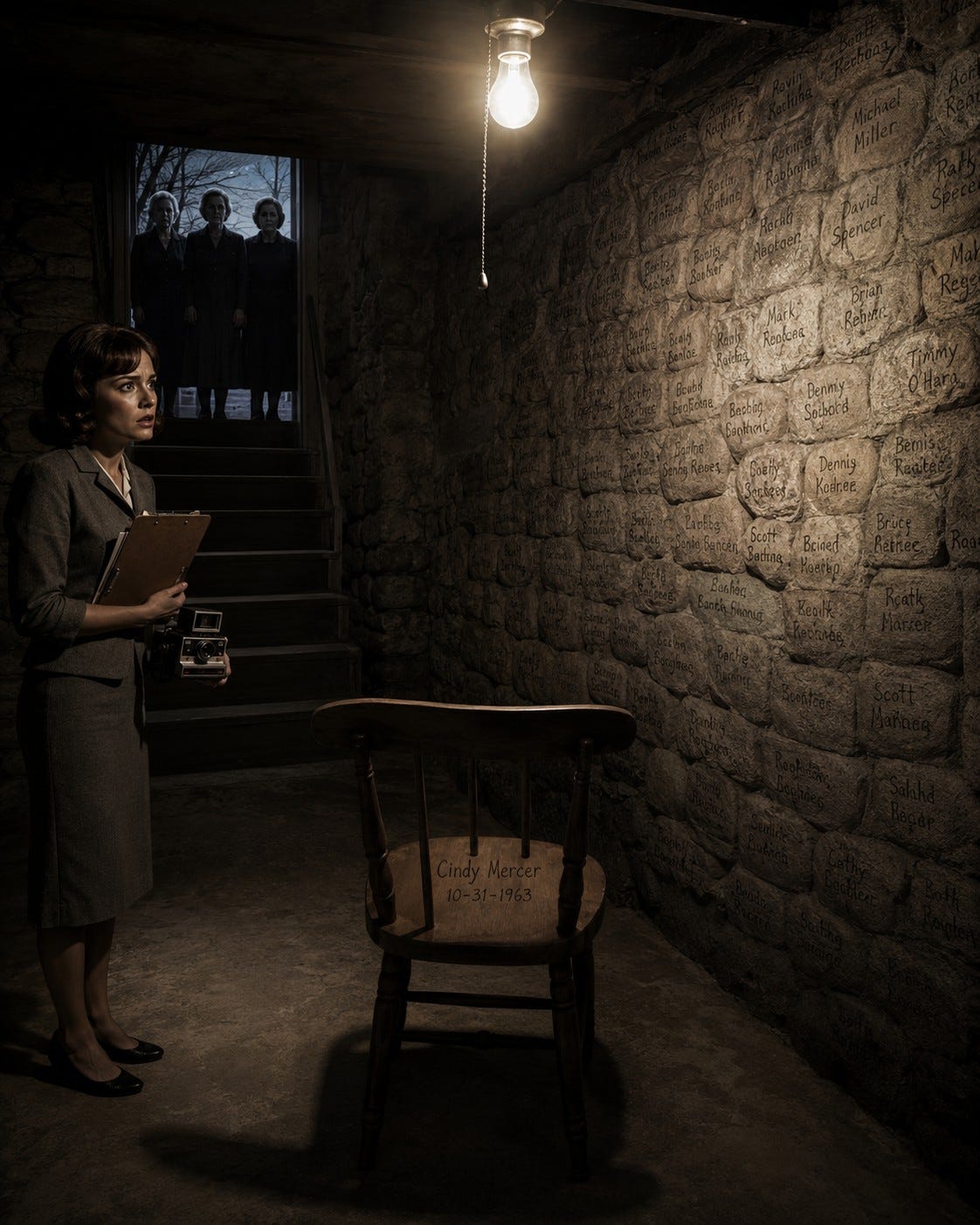
The stairs were steep and narrow and she pulled a chain at the bottom and a bare bulb came on. Active electric. Live account. Someone was paying a utility bill for a basement that officially did not exist.
She went down.
The room was large, low-ceilinged, fieldstone walls, concrete floor. Spotless. A single metal shelf unit against one wall, empty. In the center of the room: a wooden chair, facing away from her, facing the far wall.
She crossed the room to look at the wall and felt the floor drop out from under her.
Names. Floor to ceiling, edge to edge, written in pencil. Some gray and faded with age, some dark enough that the graphite still caught the light. First names, most of them, some with ages penciled alongside. Callie, 7. Marcus, 9. Thomas, 6. Bria. Lily, 8. More than she could count. She scanned upward and they continued past what the bare bulb lit well, dissolving into shadow near the ceiling where the fieldstone met the sill joists.
She knew some of these names. You lived in Mercy Furnace for two years and you knew. You heard things. You saw the flyers at the post office and the diner and the hardware store, the flyers that went up and stayed up because the children they described did not come home. Callie Doerr, age 7, missing since April. She’d seen that one pinned to the board at the post office for six months, the paper going soft at the edges.
Here was Callie. Penciled on a basement wall with a small symbol beneath her name: two lines crossing at an angle with a circle at the intersection, drawn with the precision of draftsmanship.
The same symbol under every name.
She stepped back and her calves found the chair and she caught herself on the chair back and looked down and saw what was written on the seat.
Cindy Mercer. In something darker than pencil. Beneath it, a date.
Today’s.
—
She went up the stairs. She was not aware of deciding to go up the stairs. Her body had made the decision without consulting her, and her legs were carrying out the order, and she hit the push-latch too hard with both palms and stumbled through the coat closet and into the hallway and stood there with her back against the plaster wall.
Her chest had no room in it. Someone had pressed a knee against it from the inside, and no matter how she pulled at the air she could not fill her lungs to the bottom. Her legs were soft and wrong beneath her, the knees barely doing their job. She pressed both palms flat to the wall and pushed back against it, using the wall to hold herself upright while her body decided whether her legs were going to continue their arrangement with her.
The front door was twelve feet away.
The hallway had gone profoundly quiet, the quiet of a place that is not empty, the quiet of held breath, and the air was thick and warm in a way it had not been when she came in, the same sweetness from below now filling the hallway, and her thoughts were coming apart before they could finish themselves — call someone, call — the names on the — her name on the — — and underneath the broken thoughts her body had already made its decision and was simply waiting on her legs.
She pushed off the wall.
They were in the living room.
—
Three of them. Arranged in the room as if they had chosen their positions carefully and then waited. Old women — though old was the word her mind grabbed first and then couldn’t quite close around, because there was something underneath the oldness that didn’t match it, something without age that was wearing age the way a person wears a coat. They were dressed plainly, dark clothing, nothing that would have turned heads on the street. Two of them were standing. The third one, the one nearest the door, was seated in the single wooden chair from the living room set Cindy had photographed an hour ago, and she was looking at Cindy with a stillness that no living person has in their face.
“Close the door,” the seated one said.
Cindy did not close the door. What she did was stand in the doorway with her clipboard against her chest like a child holding a book, one foot already angling back toward the hallway.
The tallest one stepped forward — and as she moved, the front door at the end of the hallway behind Cindy slammed shut with a concussive force that shook the wall and jolted the wire hanger in the coat closet into a brief, rattling spin. No draft. No hand. Nothing near it. The woman had not looked at it, had not gestured toward it, had simply stepped forward and the door had decided to obey. The sound of it rang in Cindy’s back teeth and in the base of her sternum and she spun toward the hallway on reflex and saw the door and then looked back at the woman and understood that she was meant to understand.
She was thin in the way that certain things are thin — branches, wire, the edge of a blade — and when she moved the air in the room moved differently around her, the way water moves differently around an obstruction. She stopped two feet from Cindy and looked at her with eyes that were the color of weathered stone, and they did not blink at a natural interval, and Cindy was counting the seconds between blinks because it was the only thing her mind could do that felt like control.
“You’re frightened,” the tall one said.
“Yes,” Cindy said. The honesty surprised her.
“Good.” She said it plainly, without cruelty, the way you confirm a fact. “Frightened people listen. We don’t like to repeat ourselves.”
The third woman — the one who had been holding something since Cindy first saw her, a small cloth bundle tied with dark cord — moved to the center of the room. She set the bundle on the floor and crouched over it and placed both hands on it, and the smell that had been in the basement was suddenly everywhere, filling the room, filling Cindy’s throat and sinuses and the back of her mouth, sweet and ancient and biological, and Cindy’s stomach clenched and a thin column of heat rose in her throat.
Then the bundle moved.
It moved once, a single pulse, like something breathing beneath the cloth, and the sound it made was small and high and unmistakable.
It was a child’s sound.
Cindy’s hand went over her mouth. Her knees dropped. She grabbed the door frame with her other hand and held it because without it she was going down, her legs had finished their negotiation and the answer was no, and she held the door frame and pressed her hand over her mouth and stared at the bundle on the floor.
“Look at me,” the tall one said.
Cindy looked at her.
“That is not for you to concern yourself with. Do you understand me? You will not concern yourself with that.”
Cindy said nothing. She was breathing through her nose in short pulls, her hand still over her mouth, her knuckles bone-white on the door frame.
The tall woman stepped closer. Close enough that Cindy could see the grain of her skin, the extraordinary stillness of her, the absence of the small reflexive movements that living people make without knowing they’re making them — the slight shift of weight, the micro-adjustments of balance, the unconscious blink. She stood as if she had been placed.
“There is a property on Marsh Creek Road.” Her voice had dropped, and it was not a whisper but it had the quality of one, the quality of something spoken in close proximity to the ear regardless of the distance. “You know the one.”
“I don’t.” And then something turned over in Cindy’s memory and she did. The old Aldren property, the one the other agents in the office went silent around, the one she’d asked Carl Briggs about once and he’d looked at his desk and said nothing worth showing and changed the subject with the precision of someone who had changed it many times before.
“It comes to market in the spring,” the woman said. “When it does, you will take the listing. You will show it only to buyers that we send you. You will ask no questions — about the buyers, about the house, about the terms. You will close the sale, collect your commission, and go home.” She paused. “And you will do this again when we ask you to. And again after that.”
Cindy heard herself say: “And if I don’t.”
The woman looked at her with those stone-colored eyes for a long moment. Then she reached out and touched Cindy’s face.
The touch lasted perhaps two seconds. The woman’s fingers rested against Cindy’s left cheek with a gentleness that was the most frightening thing that had happened in this room, and behind Cindy’s eyes — not in front of them, behind them, inside her skull, in a place where sight was not supposed to happen — she saw something.
A room like the basement. Walls like the basement. Names.
And at the bottom of the wall, in fresh pencil, dark and sharp: a name she recognized. Not hers. Her younger sister’s. Ruth, 20. And next to it the symbol. Two crossed lines and a circle at the intersection, and below the symbol, space — blank space left deliberately, the way a form leaves blanks to be filled in later.
The woman lowered her hand.
Cindy’s legs gave out from under her fully, and she went down against the door frame, her back sliding down the wood, and she sat on the floor with her knees pulled up and her arms around them because her body had decided this was the correct shape for the current situation and she had no argument left to make.
“Your sister lives on Garnett Street,” the seated woman said from across the room. She had not changed position. Her voice was mild. “She has two children. They walk to school on Tuesdays and Thursdays because your sister works those mornings.”
Cindy’s mouth opened.
Nothing came out.
“You are not the first woman to sit where you’re sitting,” the tall one said. “You will not be the last. What you are is useful, and useful things are maintained. Useful things are not harmed.” She glanced briefly at the bundle on the floor, where the third woman was still crouched, both hands resting on it, still now. “Useless things are a different matter.”
Cindy pressed her fist to her mouth. She could feel her pulse in her teeth.
“The Marsh Creek Road property,” the tall woman said. “Spring.”
She stepped back. The air moved differently again and the smell began to thin, the sweetness fading, and the third woman lifted her hands from the bundle and stood, and whatever Cindy had heard — whatever small and high and unmistakable sound had come from beneath that cloth — did not come again.
“You’ll feel better once you’re outside,” the seated woman said. Not kindly. As a technical note.
—
Cindy walked to her car. She focused on walking rather than running because some part of her understood that she could not run in front of them, that running was an invitation she could not afford to extend. She walked across the porch and down the steps and across the gravel drive and she got into her car and she put the key in the ignition.
She sat there.
Her hands were on the wheel and they were shaking and she watched them shake with the detached interest of a person watching something happen across the street. She pressed them flat against the wheel and they shook against it. She pressed harder. They did not stop.
She looked at the house. The front door was closed. The windows gave back only the gray October dusk and the tree line and a section of empty road. Nothing moved in the windows. Nothing moved in the yard.
She looked at the clipboard on the passenger seat. At the listing. At the photograph clipped to the front of the file.
She turned the photograph over.
On the back, in pencil — the same pencil as the wall, the same mechanical hand — a phone number. And below it, three words.
We’ll be in touch.
—
She drove to the end of the gravel drive and turned onto Aldren Road and drove until her hands stopped shaking enough to pull over, which took longer than she would have expected and not as long as she probably should have. She got out of the car and stood in the dead grass at the roadside and was sick into it, the way you’re sick when the body is done carrying something and simply puts it down.
Afterward she leaned against the car and looked at the sky, which was the same sky it had been an hour ago, gray and falling toward dark, doing nothing at all.
At some point she realized she was thinking about the Marsh Creek Road property. About spring. About what she would need to research, what she would need to know, how she would handle buyers she was not permitted to question about things she was not permitted to ask.
She searched herself for when she had decided to do it and could not find the moment.
She got in the car.
Her life had divided. She could feel the line of it, the clean seam between the woman who had turned off Aldren Road onto that gravel drive two hours ago and the woman behind this wheel now, and the woman behind this wheel understood something the other one hadn’t: that the choice had never been hers. That the listing had come to her desk because they had put it there. That the lockbox had opened because they had allowed it to open. That the entire afternoon had been a door, and she had walked through it believing she was the one who’d decided to open it.
Ruth lived on Garnett Street.
Her niece and nephew walked to school on Tuesdays and Thursdays.
Cindy put the car in gear and drove back toward Mercy Furnace, toward the mill smoke and the church steeples and the good postwar prosperity of a town that did not yet know what it was becoming, and behind her eyelids every time she blinked she saw a wall of names in pencil and a blank space waiting.
Spring would come.
It always did.
—
The property at Marsh Creek Road came to market in April of 1963. The listing was handled by Cindy Mercer of Sheerin Realty — the office’s only female agent, and, within two years, its highest earner. The house sold in four days, cash, no inspection. Cindy collected her commission and went home.
She never spoke of the listing on Aldren Road.
She never stopped thinking about it, either.