
THE MERCY RECORDS
INTERLUDE: EARL HODGE
Mercy Furnace, Pennsylvania — October 1931
by Edward Rourke
BEFORE
At three forty-one on Thursday afternoon, before the freight’s whistle cleared the Sewickley-Donora switching yard, and before the October dark had finished swallowing the ridgeline, the rail bull named Hitch put a man off outside Mercy Furnace.
He had not meant to remember the man afterward. That was the part that stayed with him. Hitch had been putting men off freights for eleven years and the men had become a category, not faces — canvas coats and bindles and the particular vocabulary of the road. He processed them and moved on and they moved on and that was the arrangement.
This one climbed down into the high weeds beside the track without argument. That was ordinary. What was not ordinary was what he did after. He turned — before the train had fully stopped, before Hitch had time to process the direction — and he looked at the town.
Not the way a man looks at an unfamiliar place.
The way a man looks at somewhere he has been.
Hitch watched him through the car door. The man stood in the weeds with his bindle over one shoulder and his eyes on the valley below Slag Hill, and something in the quality of the looking made Hitch’s back teeth meet harder than they needed to. He told himself it was the cold off the ridge. He closed the car door.
On the return run, four days later, he would find he could not recall the man’s face. Not dimmed with time. Not blurred at the edges the way faces blur. Simply not there — the space behind his eyes where the face should have been occupied by a small, clean absence, like a word erased from a page by someone who had decided the word would not be needed again.
He did not report this.
Every man who worked the Erie line in 1931 understood there were things you did not report.
I.
At four forty-seven in the afternoon, Earl Hodge stood at the water pump behind the Methodist church and performed the mathematics the road required.
The man already there was sixty or close to it. Trail-thin. Canvas coat. A tin cup filled with practiced efficiency. Earl recognized the type the way you recognize weather before it arrives — the particular economy of a man who had reduced living to its necessary components and discarded everything else as weight.
The man’s name was Pickett. He offered it without ceremony and without being asked, which was the road’s convention: useful information exchanged at the rate of useful information.
“You staying,” Pickett said. Not a question.
“Night or two,” Earl said.
Pickett refilled the cup. Drank. His eyes had the quality Earl had seen in men who had been processing disappointment long enough that the processing had become the entire mechanism — nothing left for anything else, no surplus. Not stupidity. The opposite of stupidity.
“Slag Hill.” Pickett gestured west with the cup. “Woods up top. Good place to jungle if you’re staying the night. Bull don’t go up there after dark.”
Earl’s eyes moved to the western ridge. Second-growth timber above the slag line. The trees bare enough at this elevation that the sky came through in pieces.
“Town?” Earl said. He meant: the calculus. Food, work, which kitchens fed men and which ones called the constable.
Pickett looked at him. “Town’s all right. Town feeds you if you ask right.” He drank the cup empty. “But you don’t want to get stuck here.”
“Why’s that.”
The cup was refilled. Drunk again. The pump handle swung twice.
“Just don’t,” Pickett said. That was all he said about it.
Earl filed it the way he filed most advice on the road — entered, weighted, not necessarily acted upon. He had learned that some warnings were specific and some were general and you could usually tell which by looking at the face of the man delivering them. Pickett’s face told him nothing. That was, in its own way, information.
He spent the remainder of the afternoon working Ferree Street and the two blocks behind it. Hat in hand. A heel of bread from the kitchen door of a diner that smelled of grease and onion. A pork bone with some meat still on it, wrapped in newspaper, handed to him without a word by a woman who did not look at his face. By the time the light began to fail he had what he needed.
He did not see Pickett again that day. He would think about this later.
The climb took forty minutes in the failing light. The ridge was steeper than it looked from below, the slag giving way to real rock under the leaf cover, and Earl’s boots found the soft places on the slope by feel, the road-sense that two years had built in him without his deciding to build it. His legs knew the difference between good purchase and bad. His body had learned to move through difficult terrain the way it had once learned to move through a factory floor — by repetition, without supervision.
He was thirty-eight years old.
He had forgotten what a bed felt like in the particular way you forget things that no longer apply to your life.
He climbed toward the dark.
II.
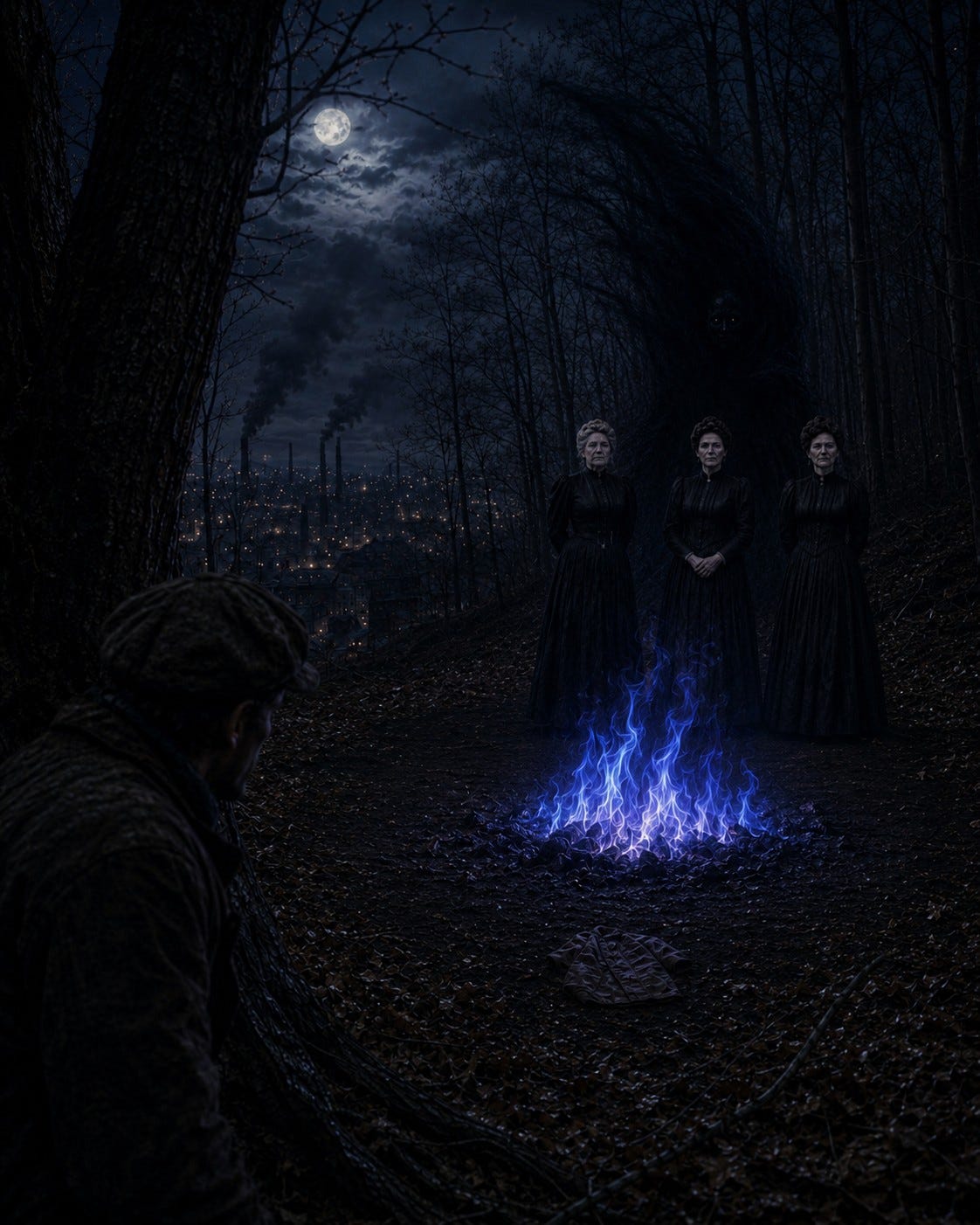
The woods were old-growth oak and hickory, the floor soft with decades of leaf fall, and in twenty minutes Earl found what he was looking for: a natural clearing sheltered on three sides, with a ring of stones that said other men had camped here and camped here often. He gathered wood from the dead-fall. He had a small fire going before full dark.
He sat with his back against an oak trunk and ate the bread and worked at the pork bone and felt, by the measure of 1931, almost well.
He was almost asleep when he registered the other light.
Not his fire. Something north and deeper in the woods — a warmth at the edge of vision, the kind the eye catches and the brain files as reflection, as its own manufacturing. He watched it for a while. He had learned, on the road, to take inventory before acting. The light was steady. It did not move or drop or gutter the way a fire moves and drops and gutters. It held.
His first thought was: another man. His second thought followed immediately: the woods were deep enough that another man’s fire should not be visible from here, which meant the other fire was large. A large fire in these woods at this hour was one of two things.
His body had already begun moving by the time his mind finished the sentence.
He put out his own fire and went toward the light.
The smell reached him before the light resolved into a shape.
Not woodsmoke. Something beneath woodsmoke — organic, faintly sweet in the way of things disturbed after long burial, present in the air below the smell of burning the way a foundation is present below a house. And underneath that, something for which his body produced no category, only a response. His back teeth came together. The muscles along his shoulders drew inward. His stomach registered it before his mind did, a signal his body labeled wrong and filed under leave.
He did not leave.
He walked toward the light.
III.
The clearing was twice the size of his camp. Roughly circular.
The trees at its edge were not simply at its edge. They had drawn back from it — not grown to the margin and stopped, but retreated over time, as if over years they had moved in the direction of away and were continuing to move at a rate too slow to observe directly but perceptible in the result. Earl noted this and filed it.
At the clearing’s center: bare earth. Nothing growing on it. Not grass, not the small persistent weeds that colonize any disturbed ground in these hills. The earth was packed hard and dark, the look of ground that has been wet repeatedly and dried and been wet again, and at its center the fire burned.
He registered the fire’s color before he registered anything else. His eyes made contact with it and his mind reached for a word and did not find one. Not orange. Not yellow. Something at the near edge of blue that shifted toward a color his vision could not resolve into a name — a color that existed at the boundary of visible and was not entirely comfortable there.
He made himself record what he saw, the way a man takes inventory.
The flames burned upward. Also sideways. Tendrils of that nameless color extending horizontally from the main body of the fire with a deliberateness that had nothing to do with wind, because there was no wind. They moved with the directed quality of something that has known where it is going for a long time and continues going there.
On the ground between the fire and the far tree line: a circle burned into the earth. Not drawn. Burned in — the symbols within it charred to a depth that implied many years of reburning, the same marks made again and again until they had become a quality of the ground itself rather than marks on it. Earl’s eyes moved over them and found no purchase. Nothing resolved into meaning. He stopped trying.
Three women stood at the fire’s far margin.
Old was the nearest available word. It did not reach. It approximated the way a far ridge approximates distance — it gave you a direction but not a destination. They were dressed in dark clothing that the firelight made darker, and they stood with the particular stillness of things that do not need to move because sufficient things move around them instead. Their faces were turned toward the fire. Their lips moved in unison. The sound they produced had the cadence and interval of speech — it had every quality of language except legibility. Each time Earl’s mind tried to grip a phrase, it went. The way a word slips when you reach for it too directly.
His body completed its inventory before his mind assembled a description.
Back teeth. Shoulders. Bladder giving one small warm warning and then holding.
He stood at the tree line and did not move.
On the burned ground, within the circle, centered between the fire and the women: a child’s coat.
Small. Dark. Folded. Laid on the earth with a care that made it worse than if it had been placed carelessly — laid the way you set down something you are setting down for the last time and want, despite everything, to set down correctly.
Earl looked at it for a long time.
The chanting changed in register.
Not in volume — it had presence rather than volume, the quality of cold in a room rather than a sound in a room — but in register. Something lower entered it. He felt the lower register in the soles of his feet and in the meat of his palms before he could have said he heard it. A frequency below ordinary sound that his body registered as warning, specifically and without ambiguity.
The fire moved.
All of it at once. Sideways. Toward the coat. It held there at an angle fire does not hold, and from the far tree line, out of the dark between the trees, something came forward.
He would spend years trying to find the word for what came out of those trees, and he would not find it. Not because the thing exceeded language — he came to believe, later, that it did not — but because description requires a witness who can be believed, and Earl was going to lose that. What he could say, what he said to himself in the long inventory of sleepless nights that followed, was this: it had mass. It had presence. It moved with intention. When it entered the fire’s light, the light did not illuminate it. The light bent around it, the way light bends around a thing that has decided not to be seen.
It stopped at the edge of the burned circle.
One of the women crouched. She lifted the coat in both hands, holding it with the careful attention you give to something you know is empty and also know is not. She held it toward the fire.
The fire took something from it.
Earl could not see what was taken. He felt it leave — the way you feel a change in pressure before weather arrives, a shift in the air that has no visual component, only a bodily one. Something left the coat, moved through the fire, and entered the thing at the edge of the circle. The thing received it with a stillness that was, of everything Earl Hodge witnessed that night in October of 1931, the most difficult part to carry afterward.
The woman set the coat down.
The thing withdrew into the trees.
The fire went out.
Not down. Not guttering. Out — instant and complete, the clearing dropping into a darkness so total that Earl’s eyes found nothing to work with. He stood at the tree line unable to see his own hands. The darkness had weight and specific gravity. It pressed against him with the patience of something that has learned to wait and has been waiting long enough that waiting has become a quality of its nature.
Footsteps on the leaf floor.
Deliberate. Unhurried. Coming from the direction of the clearing.
Earl ran.
IV.
He ran north because north was away from the clearing. He ran with his hands out in front of him for the branches. He ran for what felt like long enough to cover a quarter mile, which in these woods should have taken him past the tree line and onto the open slope of the ridge.
He ran into his own camp.
He stopped.
He stood in the ring of cold stones and looked at the dark trees around him and understood what he was looking at. His bindle against the oak trunk. The stones exactly as arranged. He had not circled — he was certain of the direction, he had not turned — but here was his camp.
He picked up the bindle and walked south.
South was the slope. The town below. The road.
He walked for twenty minutes and came back to his camp.
He tried east. He walked until his legs began to complain and the darkness was the specific darkness of deep woods far from any light source — the absolute darkness that does not accept the eye’s adjustment. He walked past the point where his legs wanted to stop.
He came back to his camp.
He sat down in the leaves beside the cold stones because there was nothing else to do, because every direction returned him to this point with the mechanical indifference of a device performing its function, and he sat there and breathed and tried to construct a thought that would be useful and could not complete one.
The silence in the woods was the same silence that had followed the fire going out. It had weight and specific gravity and it pressed against his ears with a patience that was not indifferent. He did not think it was indifferent. He thought it was waiting for something particular.
He tried west.
He came back to his camp.
He sat down and did not try again.
—
They came at first light, when the darkness had thinned to gray between the trunks, and he did not hear them coming because they did not make sound when they moved. One moment he was alone with the cold stones and the next they were at the edge of the clearing — all three, in their dark clothing, in the early light that made their faces difficult to resolve.
Earl had not stood. He looked up at them from the cold ground and said: “I didn’t see anything.”
The largest lie he had told in two years on the road. They knew this. He knew they knew it. He said it anyway because it was the only available position.
The one in the center crouched in front of him.
Up close, her face was the same as it had been across the clearing — ageless in the way stone is ageless, the smoothness not of youth but of long wear, the surface quality of something that has been in contact with weather for longer than weather is supposed to last. She looked at him with the full attention of someone reading, and what she was reading was him, and the reading did not take long.
“I didn’t mean to,” Earl said. “I saw the fire. I was cold. I didn’t mean—”
“You saw,” she said.
Not an accusation. A notation. The way a doctor notes a symptom, the way an entry is made in a ledger: not judgment, simply fact. The fact being entered.
“I won’t tell anyone,” he said. “Who’d I tell? Who’d believe me? I’m nobody. I’m just — I’m passing through. I’ll be gone by morning.”
She looked at him for a moment with something that might, in a different kind of face, have been consideration.
Then she placed both hands against the sides of his head. Her palms were cold — cold specific enough that he flinched from it, the cold of old metal, of something kept below ground for a long time. She said one phrase in that language. Brief and precise. The economy of a key in a lock.
Earl felt something happen.
He could not describe it as pain. The nearest available word — the closest he could get in the years that followed — was the feeling of a word leaving memory. That small interior erasure, the brief vacancy where something was and then is not. Except that what left him was not a word. It was larger than a word. It was the thing a word points at. The essential quality that causes others to register that a person exists in the same room with them — that specific legibility, the invisible signal the human presence broadcasts and other humans receive without knowing they receive it. He felt it leave. He felt the exact shape of the space it left.
She lowered her hands and stood.
“Go,” she said. “The road is open.”
—
He walked out of the woods in twenty minutes.
Down the slope and onto the streets of Mercy Furnace, and the first person he passed — a mill worker in a heavy coat heading toward the gate on Vance Avenue looked through him in the same motion as looking at him. The eyes made contact and found nothing registered there and moved on.
Earl stopped. He said, “Excuse me.”
The man walked past without adjusting his stride.
Earl put his hand on the man’s arm.
The man paused with the mild, practical confusion of someone who thought they felt something, looked around in the way of a person late for a shift, found nothing, and walked on.
Earl let go of the arm.
He left Mercy Furnace that morning. He walked to the rail yard and climbed into a northbound boxcar and no one stopped him and no one saw him, which was the first practical application of what had been done to him and the last thing that operated as a benefit for a very long time.
He rode the rails for years after that.
He sat at fires in hobo jungles and spoke and was not heard. He stood at soup lines and was not served. He slept in flophouses and was not charged. He sat in the back pews of churches during sermons and no one turned toward the sound of his weight settling.
He tried, twice, to write down what he had seen in the clearing. The sentences came out wrong — not false, he could tell they were true, as true as anything he carried — but unreadable. The words dissolved before they formed meaning, as if the language itself had received an instruction not to carry this particular cargo.
He tried to find Mercy Furnace again.
Not because he expected restoration. He understood, within a few months, that restoration was not available. He went because he had left something in the burned circle on Slag Hill. Left it without consent, left it under conditions that had not been his to refuse. And because a man who has had something taken from him carries the fact of the taking forward in a way that requires occasional inventory. He needed to look at the location. To verify the ledger.
He never arrived. He followed the route and came out somewhere else. He accepted this eventually the way you accept weather: as a condition rather than a decision, as something the world had settled on and was not reconsidering.
He grew old on the road. Older than he had reason to expect, or exactly as old as the mechanism required. He was never entirely certain how the mechanism worked. Whether what they had taken was something mortality required for its normal operation, or something adjacent to it, something he lacked the instrument to measure. He did not die in the timeframe he had expected to die in. He went on. Nobody saw him go.
The child’s coat stayed in his mind with complete clarity for the rest of his life.
The color of it. The care with which it had been laid on the burned earth. The way the fire had taken something from it. Not burned it, not destroyed it, but extracted something from it with precision and intention — and carried that thing into the dark.
He had not understood, the night he watched it, what the transaction meant.
He had sufficient time to work it out.
Understanding did not make it better.
It made it the other thing.
There is no record of an Earl Hodge in the census of 1930, the census of 1940, or any municipal roll, arrest record, or relief registry from the period. The name does not appear in the files of the Mercy Furnace Relief Office, which documented every transient who passed through the county between 1930 and 1935.
Those same files contain four reports from citizens describing a man at the edge of town. Always alone. Always still. Always gone by the time anyone looked directly at him. The reports are dated across four consecutive days in October 1931. They were filed by four different citizens. No description in any report is consistent with any other.
Each of the four citizens, contacted the following day, was unable to remember filing a report. Three of the four were unable to remember the previous day entirely.
The fourth, Arnold Pickett, retired, Clement Street, gave a statement that consisted of one sentence. He said he had been at a water pump behind the Methodist church and had spoken to a man and told the man not to stay, and the man had stayed anyway, and that was all he knew about it.
When asked to describe the man, Pickett said: I don’t remember his face.
When asked what the man had done wrong, Pickett said: Nothing. That wasn’t the point.
When asked what the point was, Pickett said he had already answered that. The investigator could read the statement.
The investigator read the statement.
Pickett said: That’s right. That’s all of it.
He did not say anything further. He was eighty-one years old and he had lived in Mercy Furnace his entire life and he understood what a statement was for. It was to make a record. To say: something happened here, and the knowing of it is what I can offer, because the something itself is no longer available for examination, and that is the nature of things that happen in Mercy Furnace, and has always been.
The Relief Office files were sealed in 1971 and transferred to the county historical archive in 1989.
The four citizen reports were removed from the file at some point between those dates.
The removal is not noted in the transfer index.
No one who handled the file in that interval can be identified.