INCIDENT FILE 58-10-22
{from THE MERCY RECORDS, season one}
THE MERCY RECORDS
INCIDENT FILE 58-10-22
Patrol Three — Officer Thomas Keegan
October 22, 1958
— — —
BEFORE
Thomas Keegan became a policeman because of arithmetic.
Not the arithmetic of crime and punishment. The other kind. The kind his father understood without ever naming it: that every community ran on a set of invisible books, and someone had to keep them. Someone had to know who was home and who wasn’t. Who had a warrant and who had a grievance and who had been drinking since noon on a Tuesday. Someone had to stand between the town and the thing that would happen to any town if no one stood there.
His father had kept ledgers at the mill for thirty-one years. Same principle.
You counted what was there. You noted what was missing. You recorded what could be verified and kept your opinions about the rest to yourself.
Keegan had been doing this for nine years, four months, and eleven days by the time October arrived.
He believed in it.
That was the thing, later, that he couldn’t shake.
Not that he’d been afraid. Any honest officer admitted fear. Fear was procedural. Fear sharpened the senses and slowed the hands and kept you from doing something stupid in a dark ditch at two in the morning.
What he couldn’t shake was that he had believed, right up until he couldn’t anymore, that his training would protect him. That procedure was a kind of armor. That a man who documented everything correctly was a man who remained in control of what he had documented.
Mercy Furnace had let him believe that for nine years.
Then it had asked him to test it.
— — —
I. Dispatch
He was logging mileage when the call came.
2:17 a.m. He had just written 4,881 in the column and was reaching for the shift-start notation when the radio broke open.
Not static first. The opposite. A silence so deliberate it had shape — the silence of an open line, a keyed microphone, someone on the other end who had decided to breathe instead of speak.
Then the dispatcher’s voice. Ruth Hadley. Fourteen years on the overnight, voice like a woman who had given up being surprised.
“Patrol Three.”
Pause.
“Possible juvenile.”
Pause.
“Slag Hill Road.”
Keegan waited. Dispatchers filled silence. It was the job. Description. Last known direction. Parent’s name, if known. Whether the reporting party was still on scene. Ruth Hadley had filled silences for fourteen years without being asked.
The radio hissed.
He thumbed the handset. “Dispatch, Patrol Three. Can you repeat a description?”
Nothing.
Not disconnected. He knew disconnected. Disconnected had a sound — a specific absence that meant the signal had broken. This was something else. This was an open line with someone still there, simply choosing not to speak.
Then a soft click.
Not a transmission ending.
The sound of a microphone being set down.
Carefully.
Like setting a glass on a table in a room where something was sleeping.
Keegan wrote the call in his log. 2:17. Possible juvenile. Slag Hill Road. He wrote it the same way he wrote everything — clear block letters, enough detail to reconstruct the sequence, no editorializing.
He pulled out of the parking lot on Second Street and drove north.
— — —
II. Slag Hill Road
Every town had a register.
Keegan had learned this without anyone teaching it to him. You worked a town long enough and you understood its sounds — not just the sounds, but the silence between them. Pittsburgh sounded mechanical, even at three in the morning. Gears and distant steel. Moon Township sounded empty, but it was a comfortable empty, the empty of a place that had simply gone to bed.
Mercy Furnace counted.
He had never said this to anyone. You could not put it in a report. But driving the midnight shift through nine years of October, November, February, March — the cold months, the months when the streets thinned out and the dark thickened — he had felt it. Some streets waited until you passed to resume their noise. Some corners held their breath until you turned away.
Slag Hill Road was the worst of them.
He drove without the radio now. Habit. You listened to the town before you listened to the dispatcher. Delaney’s Barber Shop passed on the left, the striped pole standing motionless in the dark. Mancini’s Bakery. The Rexall with its hand-lettered sale signs still visible through the glass. The volunteer fire station. Then the streets thinned. The buildings fell back. The trees came forward.
The wipers crossed once.
Rubber whispered across dry glass.
No rain. Keegan shut them off.
The cruiser smelled the way all cruisers eventually smelled after enough shifts: wet wool and leather, the oiled canvas of the Sam Browne belt, burnt coffee from the bottom of the pot at end of shift, the faint chemical smell of mimeograph paper, the ghost of every cigarette smoked by every officer who had driven this car since 1953.
He knew the smell the way he knew the sound of the engine, the way the steering pulled slightly left on cold mornings, the specific rattle of the passenger door handle when the road got rough.
He knew this machine.
That mattered, later.
Slag Hill Road appeared in the headlights as it always did — a narrow two-lane that curved northeast before straightening at the base of the hill. Gravel shoulders. Drainage ditch on the right. The chain-link fence beyond it, and beyond the fence the dark rise of the hill and the treeline that had swallowed the old works.
Nothing in the road.
Nothing in the ditch.
Nothing at the fence.
Keegan pulled to the shoulder, fifteen feet past the fence line. He killed the headlights.
He sat.
Officers who survived learned to use the dark before fighting it. You killed the lights and you waited for your eyes. You listened with the engine off and you let the world tell you what it was before you went into it.
Engine ticking. Cooling manifold.
A dog somewhere beyond Clement Street, three blocks south — he tracked it automatically, noted the distance, confirmed it was moving away.
Then nothing.
Not quiet. Quiet had texture. Quiet meant crickets, wind, the creak of a tree, a car passing on Route 8 a half-mile north, a freight train so distant it was more vibration than sound.
This was something else.
This felt withheld.
As though sound had been present a moment before and had stopped, specifically, for him.
He noted it. He did not write it down.
— — —
III. The Ditch
He took the flashlight from the door mount. A three-cell Ray-O-Vac, heavy, the kind that doubled as a club if the situation required. He checked the beam against the floor mat. Strong. Good.
He stepped out.
October air, thirty-eight degrees, carrying the wet-leaf smell of the ditch and underneath it something else — not rot, not sulfur, but something that reminded him of the inside of the old icehouse on Canal Street before they tore it down. Deep cold. Preserved cold. The kind of cold that lived in stone.
He buttoned the top button of his coat. Swept the beam left.
Gravel. Goldenrod gone brown. A beer bottle catching the light and throwing it back. A crumpled Lucky Strike pack. Rusted fence post. Chain-link.
He swept right.
More fence. A section where the bottom rail had been pushed up from the ground — old damage, old repair, the kind of thing you logged and forgot. Mud in the ditch.
He swept down.
The beam crossed the ditch bank and stopped.
Keegan hadn’t told his hand to stop.
It simply had.
He crouched.
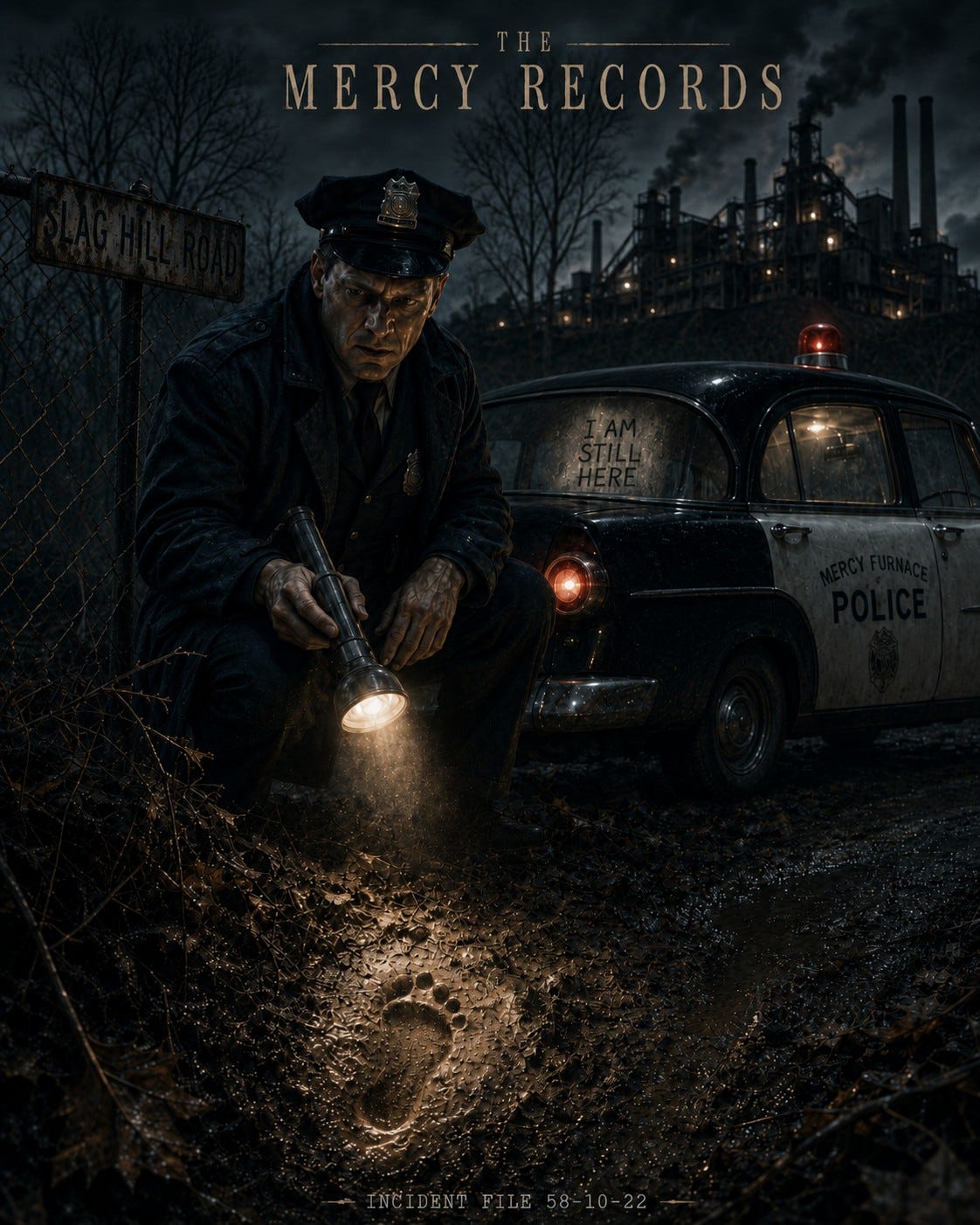
One footprint. Left foot. Child’s foot — he measured it against his own palm by instinct, smaller than his hand, maybe seven years old, maybe eight. Barefoot. The toes had spread slightly, the way bare feet spread in soft mud.
He looked for the right foot.
He looked for any other print.
He moved the beam in a careful arc — left, right, behind the print, in front of it along the fence line.
One print.
He was forty-one years old. He had worked nine years of midnight shifts. He had delivered three babies in the back seats of cars, pulled two drowning boys from the Monongahela, worked three fatal accidents on Route 8, and once sat with a man for four hours on a railroad bridge until the man climbed down.
He had never stood over a single footprint with no partner print and felt his mind simply stop.
He pressed one finger into the mud beside the impression.
Cold.
Not October cold. Not outside-at-two-in-the-morning cold.
Cellar cold. The cold that lived in the dark under houses, the cold that stone kept through July, the cold that had never been warm.
He stood too quickly.
The blood left his head in a single slow drop, and he took one step back and put his hand on the fence post and breathed through his nose and waited for the dizziness to pass. Procedure. When your body does something unexpected, you stop. You verify. You do not react.
He breathed.
He looked at the fence post under his hand.
The chain-link beyond it.
The hill beyond that.
Nothing moved.
The air pressed against his face like something was pushing from behind it.
He had been holding his breath.
He didn’t know for how long.
He released it and the condensation rose in a plume and vanished and the cold rushed back in and he made himself look at the print again. One print. Barefoot. October. Fresh mud, water still seeping into the impression at the heel. Twenty minutes old. Maybe less.
He looked for the return prints.
There were none.
— — —
IV. The Cruiser
He radioed dispatch.
Open carrier hiss.
He tried twice more, changed frequencies, tried the secondary channel, tried the emergency band.
Nothing.
Not interference. Not a dead transmission. An open, occupied line with no one on it.
He took the flashlight to the perimeter of the scene. He did it correctly — spiraling out from the single print, noting landmarks, checking the fence for disturbance, checking the ditch bank in both directions. Forty-five minutes. He found nothing else. No additional prints. No clothing. No sign that a child had climbed the fence or descended from the road or come from the tree line.
One bare foot had pressed into the mud.
No second foot.
No return.
He had just turned back toward the cruiser when the radio spoke.
Not from the dashboard.
He stopped walking.
The dashboard was fifteen feet away.
The voice came from inside the cruiser, through the closed window, at a volume that suggested the handset was keyed and someone was close to the microphone.
A child’s voice.
One word.
Please.
The dome light was on.
He had not opened another door.
He walked back. Slowly. Flashlight on the cruiser, on the windows, on the back seat.
Empty.
He opened the driver’s door.
The dome light went off.
He stood with his hand on the door frame and looked into the back seat for a long time. Vinyl bench. Wire divider. The scarred floor mat. A forgotten evidence envelope that had been back there for three weeks.
Nothing.
He got in. He checked the mirror. He checked the rear window.
He picked up the radio handset and tried dispatch again.
While he was keying the microphone, he saw it.
The rear passenger window.
Fogged.
Not all of it. A section, hand-sized, as though someone had breathed against the glass from the inside.
He had the handset in his left hand. He did not put it down. He reached back with his right hand and touched the glass.
Warm.
He pulled his hand back.
Letters. Four words. Written in the fog in careful primary-school printing, each letter spaced with the patience of a child trying to do it right.
I AM STILL HERE
He looked at the letters.
He looked at the empty back seat.
He looked at the letters again.
The I disappeared.
Not smeared. Not fading the way breath-fog fades — evenly, together. The I simply stopped being there. Then AM. Then STILL.
He was watching the R in HERE when his bladder clenched, hard and sudden, animal fear bypassing everything, and he pressed his hand against his leg and breathed through his teeth and held it and held it until the sensation passed.
HERE disappeared.
The glass was dry.
He had not understood, before tonight, that there was a difference between being afraid of something and being afraid inside something. He understood it at 3:04 a.m. on Slag Hill Road, with his hand on his leg and his breath fogging his own side of the glass.
His notebook was gone.
Left breast pocket.
He patted himself. He checked the seat. He checked the floor.
He heard paper.
One page turning.
The notebook was on the rear seat. Closed. Laid flat, spine aligned with the edge of the cushion, with the precise placement of something set down by someone who had been careful about it.
He had not put it there.
He reached back and took it.
The leather cover was warm.
He opened it to the last written page — the log entry, 2:17, Slag Hill Road, one print, no description — and turned to the next blank page.
It was not blank.
Blue ink. His department-issued pen. His handwriting, almost — the same hand he’d developed at the academy, the compact block print they’d all been taught — but not quite. Slightly rounder. Slightly more careful. The handwriting of someone who had learned to write from his handwriting and had not yet stopped trying.
REPORTING OFFICER: THOMAS KEEGAN
TIME: 2:17 A.M.
DISPOSITION: SUBJECT RETURNED
PRESENT MEANS ACCOUNTED FOR
He closed the notebook.
He put the cruiser in gear.
He drove.
— — —
V. The Report
He spent two hours on the report.
He did it correctly. He had no choice — a call was logged, a call required documentation, documentation was the difference between a department and a mob. He typed at the desk in the bullpen while the overnight sergeant slept in the back office and the clock on the wall moved from 3:50 to 4:12 to 4:31.
He typed: POSSIBLE LOST CHILD — SLAG HILL ROAD — 2:17 A.M.
He pulled the page from the typewriter.
It read: RETURNED.
He set it aside. He wound a fresh sheet. He typed the incident number, the date, his badge number, the time, the location. He typed: While on routine patrol I was dispatched to the report of a possible juvenile at the intersection of Slag Hill Road and County Line. Upon arrival I located one (1) juvenile footprint in the ditch bank approximately fifteen feet south of the fence line. The print was—
He pulled the page.
RETURNED.
He tried three more times.
Same word. Different position on the page each time, as though it was moving to where he hadn’t typed yet.
He handwrote it.
Blue ink, careful letters, his best court-testimony handwriting. He wrote for forty minutes. He described the dispatch call, the drive, the dark, the single print, the temperature of the mud, the fogged window, the notebook. He used no language he couldn’t defend. He wrote only what he had observed, in the sequence he had observed it.
When he finished, he sat back and read it from the top.
His handwriting changed three words in.
Not all at once. Not dramatically. The letters became rounder. Younger. The O’s opened slightly at the top. The T’s sprouted small serifs. By the sixth line, what was on the page was not his handwriting.
It was second-grade handwriting.
Patient. Careful. A child trying to earn a gold star.
He looked at the report for a long time.
Then he folded it once, lengthwise, and put it in his coat pocket.
He did not file a report for Incident File 58-10-22.
There is no official record.
— — —
AFTER
He got home at 4:47.
The house on Garrett Street was quiet. Eleanor asleep. He could hear her from the hallway — she slept hard, deep, without sound, and he’d learned to find comfort in the specific rhythm of it. He hung the duty belt on the peg by the door. The revolver went in the lockbox. The boots came off at the mat.
He washed his hands at the kitchen sink. Watched the mud come off his fingers and spiral away. Dried his hands on the dish towel. Ordinary.
He was ordinary again. He could feel it — the specific weight of a familiar house, the smell of his wife’s hand cream on the dish towel, the creak of the third step, all of it pressing back against what Slag Hill Road had done to him.
He went down the hall to check on Molly.
She was three. She slept with one arm around a stuffed rabbit that had been white at Easter and was gray-brown now, beloved down to structurelessness. The nightlight made a soft orange circle on the wall above the dresser.
He stood in the doorway.
He looked at his daughter sleeping.
He saw the notebook.
On the floor.
Beside the crib.
Closed. Spine aligned with the crib leg. Set down carefully.
He had locked it in the cruiser.
He knew this the way he knew the sound of his own engine, the way the steering pulled left, the specific weight of his own coat. He had locked the notebook in the glove box at 4:39 a.m. and driven home and come inside.
The notebook was on the floor of his daughter’s room.
He did not move for a long time.
His legs wanted to. That was the thing — his legs had made a decision several seconds before his mind caught up, and the decision was backward, away, out of the doorway and down the hall. He overrode it. Nine years of training. You don’t run. You assess.
He looked at his daughter.
Asleep. Breathing. The rabbit under her arm.
One hand outside the blanket. Palm down, fingers slightly curled, resting on the sheet the way a sleeping child’s hand rests when it has let go of something.
He made himself look.
Five damp fingerprints on the white sheet beneath her palm.
Small.
Spaced wrong for her hand.
He picked up the notebook.
He did not open it standing there. He took one breath, two, and opened it.
One new page.
One sentence.
Written in the careful second-grade printing he recognized now.
WE COUNT YOURS TOO.
Officer Thomas Keegan stood in the door of his daughter’s room with his thumb holding the page and read the sentence and the sentence did not change and his daughter breathed and the stuffed rabbit held its shapeless arms around her and the fingerprints dried slowly into the white cotton sheet.
He had been a policeman for nine years, four months, and eleven days.
He had delivered babies. Pulled drowning boys from cold water. Sat with a man on a railroad bridge for four hours.
He had believed in the arithmetic. The ledgers. The record.
He stood in the doorway until first light found the window above the crib.
He did not go in.
He could not explain why, and he never tried.
He only knew that for the first time in nine years of police work, he was afraid to touch the evidence.
— — —
FILE 58-10-22 — NO OFFICIAL DISPOSITION
Document recovered from personal effects, T. Keegan, Badge #114
Mercy Furnace Police Department, retired 1967
Submitted to the Mercy Records: date unknown